

The Age of “Bigger Is Better”
For the past five years, scale has been the north star of AI research. The mantra was simple: more parameters, more data, more compute. Kaplan et al.’s 2020 scaling laws at OpenAI showed that larger models predictably improved performance. The industry took it literally: GPT-3 at 175B, PaLM at 540B, GPT-4 estimated at over a trillion parameters, and China’s DeepSeek-R1 rumored to rival them in size.
Scaling worked. Each leap felt magical. But in 2024–2025, something shifted. We reached a point where bigger no longer felt like progress; it felt like inertia. A trillion-parameter model costs hundreds of millions in compute and energy to train, but the improvements were incremental, not revolutionary.
The field began to ask: is there another way?
Phi-3: The Small Giant
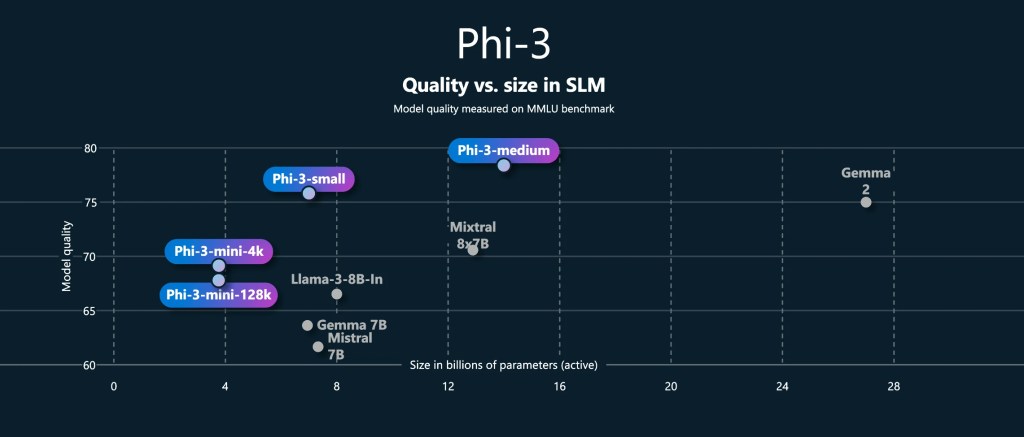
In April 2024, Microsoft Research quietly released Phi-3, a family of models as small as 3.8B parameters — a fraction of GPT-4’s size. The shock wasn’t their parameter count; it was their performance.
Trained largely on curated synthetic data, Phi-3 mini rivaled or beat models many times larger. Benchmarks in reasoning, reading comprehension, and common-sense QA showed results competitive with 7B–13B LLaMA models, sometimes even nipping at GPT-3.5’s heels.
The breakthrough wasn’t architecture; it was data quality. Instead of scraping the messy internet, the Phi team trained on carefully constructed corpora: educational content, curriculum-like synthetic examples, and filtered text designed to actually teach.
The message was clear: bigger is not the only path forward.
The Post-Parameter Era
Phi-3 was more than an anomaly. It was a signal that we are entering a post-parameter era.
The defining question is no longer “how big is your model?” but “how well does your model learn?”
The post-parameter era has three pillars:
- Data quality > raw scale. Curation, synthesis, and curriculum design beat scraping.
- Architecture modularity. LoRA fine-tunes, adapters, and composable blocks allow specialization without retraining giants.
- Distributed intelligence. Instead of one massive model, networks of smaller models collaborate, each tuned to its own domain.
Think less about pyramids of parameters, more about ecosystems of intelligence.
Breakthroughs Pointing the Way
A cluster of breakthroughs already reinforce this shift:
- Curriculum learning at scale. OpenAI and Anthropic are experimenting with structured training — teaching models step by step, like students, rather than dumping all data at once. Phi-3 validated this approach in practice.
- Synthetic-first pipelines. Models like Phi-3 generate their own training data, then filter and refine it, creating a feedback loop. DeepSeek uses similar approaches with “self-improvement data farms.”
- Distillation and shrinkage. OpenLLM projects like DistilBERT, TinyLLaMA, and Falcon-Instruct show that smaller distilled models can retain much of the performance of giants.
- LoRA adapters and composable fine-tunes. Instead of retraining a full model, developers layer lightweight modules for domains — law, finance, coding — that can be mixed and matched.
- Edge deployment. Qualcomm’s Snapdragon X Elite NPUs and Apple’s Neural Engine now run LLaMA-class models locally. Small is not just cheaper — it’s practical.
The Case for Swarms
One of the most exciting possibilities is that the post-parameter era favors swarms.
Instead of one monolithic trillion-parameter model, imagine a constellation of thousands of nano-models: each 1B–3B in size, tuned for a domain, communicating through protocols.
- A legal model specialized on case law.
- A medical model tuned on clinical data.
- A cultural model trained on literature and history.
- A reasoning model acting as a coordinator.
Together, they form a distributed intelligence that is more resilient, explainable, and adaptable than a single opaque giant.
We already see glimpses: CrewAI and LangGraph orchestrate multi-agent systems; Hugging Face’s smol-agents framework lets small models call each other. The bottleneck isn’t possibility — it’s infrastructure and protocols.
My Forward Vision: Intelligence as an Ecosystem
The next step is to stop thinking of models as products and start thinking of them as species.
Each model evolves for its niche. Some are generalists, some specialists. Some are ephemeral (a LoRA spun up for a task and discarded), others persistent (domain custodians).
Like an ecosystem, diversity matters more than sheer size. One fragile trillion-parameter giant can fail catastrophically. A swarm of small models can adapt.
This reframes AI from artificial general intelligence (one model to rule them all) to artificial ecological intelligence (ecosystems of specialized intelligences).
What Needs to Happen
To get there, we need new research directions:
- Dynamic composition. Systems that can route queries through networks of models, like packets on the internet.
- Shared semantic protocols. Standards so models can “talk” — embedding languages, memory formats, proof protocols.
- Autonomous fine-tuning. Engines that spin up temporary models when gaps are found, then merge or retire them.
- Energy efficiency. Small models run on edge devices, but we need breakthroughs in training efficiency — low-precision arithmetic, spiking architectures, neuromorphic chips.
Why This Matters for Humans
A post-parameter AI ecosystem changes the user experience.
- Personal AIs. Instead of renting access to one giant cloud model, people could own swarms of local agents tuned to their data.
- Trusted niches. Enterprises could build verified micro-models that handle sensitive knowledge, never leaving their servers.
- Cultural diversity. Small models can be tuned for local languages, norms, and values. A trillion-parameter global model cannot represent all.
- Resilience. Failure of one model doesn’t collapse the system. Knowledge and reasoning are distributed.
This democratizes intelligence. It pulls power away from whoever controls the largest models and spreads it across the network.
The Risks
Optimism requires honesty. There are risks.
- Fragmentation. Without standards, swarms could become Babels of incompatible micro-models.
- Quality variance. Not every small model will be Phi-3. Many will be junk.
- Security. Distributed swarms are attack surfaces. Poisoning or hijacking one node could ripple outward.
- Economics. Big labs have incentives to keep scaling giants; ecosystems threaten their moat.
But these are solvable. Protocols, benchmarks, and open collaboration can turn risks into strengths.
Closing: After Parameters
For a decade, “how big” was the only metric that mattered. But we are stepping into a new era where how smart, how specialized, and how well models collaborate are the true frontier.
Phi-3 was the canary in the coal mine — proof that quality, curation, and smallness can rival sheer size.
The future is not one trillion-parameter brain. The future is a network of minds, small and smart, composing intelligence together.
This is the post-parameter era. And it’s already begun.


Leave a Reply