
From Autocomplete to Understanding
Language models are powerful, but they are not grounded. They work with tokens, not the world. They autocomplete strings, not states of reality.
For years, this was fine. They dazzled with fluency, fooled us with coherence, and surprised us with emergent reasoning. But as the field matured, a deeper question emerged: what does it mean for a model to actually understand the world?
The answer has been bubbling up under a new name: world models.
The Roots of World Models
The idea is not new. In cognitive science, a world model is the internal simulation an organism uses to predict outcomes. We don’t just react; we imagine, we simulate, we forecast.
In AI, early work on model-based reinforcement learning (Ha & Schmidhuber, 2018) showed that even simple recurrent networks could learn latent dynamics — predicting future frames of Atari games without directly playing them.
DeepMind’s MuZero (2020) was a leap: a system that learned rules of environments it had never seen, planning in latent space rather than relying on explicit knowledge of the game.
The thread runs through robotics, planning, and simulation. But in 2023–25, something crystallized: world models are no longer niche. They are becoming the scaffolding for how AI might truly reason.
The New Wave of World Models
Several breakthroughs in the past two years pushed world models to the center:
- DeepMind’s GENESIS (2024). A general-purpose simulator trained across diverse 3D environments, capable of predicting physical interactions far beyond training data.
- OpenAI’s Sora (2024). A video generation model that demonstrated surprising adherence to physical consistency — objects moving realistically, forces behaving plausibly, scenes holding coherence over time.
- NVIDIA’s GR00T (2025). A robotics foundation model that learns by watching videos and sim-to-real transfer, grounding action in both simulation and embodiment.
- Meta’s data-efficient simulators. Approaches that train world models with far fewer trajectories, emphasizing transferability.
Together, they suggest a shift: from static text to dynamic latent simulations.

What World Models Can Do Today
The frontier capabilities are already impressive:
- Physics prediction. GENESIS can model fluid dynamics, collisions, and rigid body interactions.
- Video coherence. Sora generates multi-second clips where objects persist, move consistently, and obey gravity.
- Embodied transfer. GR00T robots learn manipulation skills in simulation and apply them to real-world tasks.
- Multi-agent interactions. Research at Stanford and MIT shows world models simulating crowds, cooperation, and adversarial dynamics.
These aren’t perfect. GENESIS still struggles with chaotic systems. Sora can break under long horizons. GR00T robots fail in edge cases. But the arc is unmistakable: models are learning not just language, but dynamics.
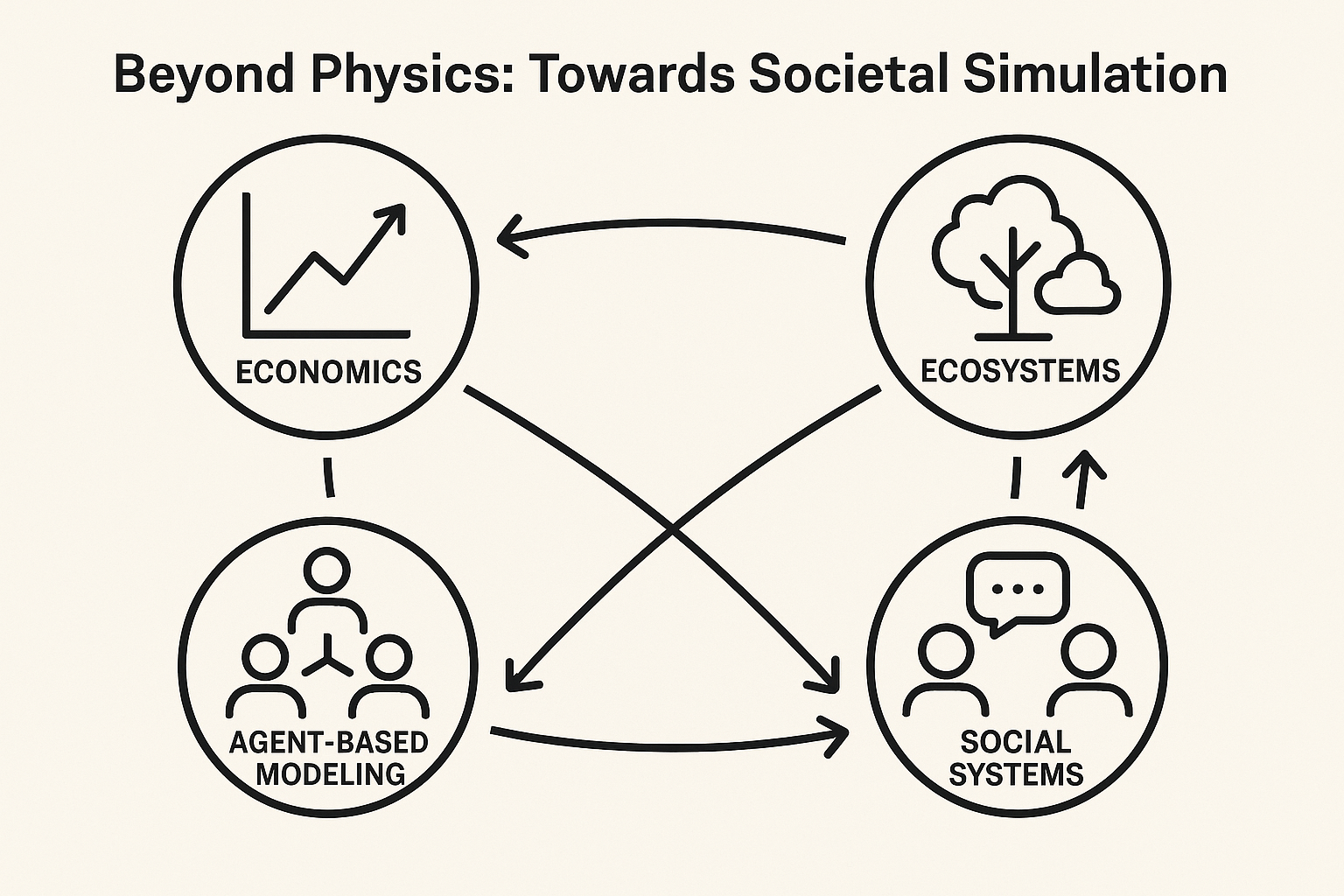
Beyond Physics: Towards Societal Simulation
Here is where I want to push further.
If world models can learn latent physics, why stop at matter and motion? Why not extend them to economics, ecosystems, and social systems?
We already have the building blocks:
- Agent-based modeling (ABM) has been used in economics and epidemiology for decades.
- LLM-driven agents (Park et al., 2023’s “Generative Agents”) simulate social interactions convincingly in sandbox environments.
- Multi-agent reinforcement learning shows emergent cooperation and competition.
The next frontier is clear: world models of society. Engines that simulate markets, political negotiations, cultural trends, or even scientific communities.
Not as deterministic forecasts, but as possibility spaces — laboratories for testing futures before they happen.
A New Metaphor: Policy Wind Tunnels
Think of how engineers test aircraft in wind tunnels. They don’t predict the future flight path exactly; they simulate flows, stresses, and turbulence to see what might happen.
World models could become policy wind tunnels for societies. Feed in proposals, simulate responses across agents, observe emergent dynamics.
- How would a new tax regime ripple through consumer behavior?
- What happens when misinformation spreads at scale?
- How do climate policies shift economic and ecological balances?
Not answers, but maps of possible futures.

The Ingredients for Societal World Models
To build this, several pieces must converge:
- Multi-agent architectures. Thousands of autonomous agents with goals, preferences, and memories. LLMs already play this role in experimental sims.
- Cross-domain data. Economics, demographics, cultural patterns, ecological data — fused into a coherent latent space.
- Dynamic feedback. Agents not only respond but adapt, learn, and change strategies over time.
- Verifiable grounding. Models checked against real-world historical data to calibrate plausibility.
This is not about one model “knowing” everything. It’s about a system of models interacting — a world of worlds.
Challenges We Must Acknowledge
Of course, this is fraught.
- Bias. World models inherit their training data. If the data encodes structural inequities, the simulations reproduce them.
- Misuse. Governments or corporations could use societal sims for manipulation rather than foresight.
- Over-trust. Simulations are not predictions. Mistaking them for oracles could lead to overconfident policy errors.
- Complexity. Human systems are more chaotic than physics. Prediction horizons will always be bounded.
But complexity is not an excuse for inaction. The alternative is flying blind.
Forward Vision: Engines of Possibility
What excites me most is not using world models to predict, but to expand imagination.
Imagine researchers running thousands of climate-policy futures overnight. Imagine citizens exploring interactive sims of how housing or healthcare reforms might ripple through their communities. Imagine entrepreneurs stress-testing new markets before launch.
World models as public goods: shared laboratories for navigating uncertainty.
This reframes AI from an answer machine into a possibility engine.
Connecting Physics and Society
There’s a poetic symmetry here. We started with models of matter — predicting motion, collisions, flows. Now we extend to models of meaning — simulating choices, markets, cultures.
Both are about dynamics. Both are about systems evolving in time. Both require engines that can imagine, test, and adapt.
World models without boundaries means bridging physics and society into a continuous landscape of simulation.
Why This Matters for Human Experience
For humans, this could transform decision-making at every scale:
- Individual. Personal digital twins could simulate health decisions, financial planning, or career paths.
- Collective. Communities could run participatory sims of local policy.
- Global. Governments could coordinate climate policy through shared world models, stress-testing strategies collaboratively.
This isn’t a fantasy. It’s an extension of trends already here: digital twins in manufacturing, epidemiological sims during COVID, multi-agent LLM experiments in social dynamics. The leap is integration.
The World as a Model, The Model as a World
Language models taught us to autocomplete sentences. World models are teaching us to autocomplete realities.
The leap beyond RAG is not just retrieval. The leap beyond LLMs is not just scale. The next frontier is engines that simulate worlds — physical, social, ecological — and let us navigate them with foresight and imagination.
World models without boundaries. Not just predicting tokens, but charting futures.
This is not the end of language models. It is their grounding. Their evolution from parrots of text to partners in possibility.
And it’s the step that will decide whether AI remains clever software — or becomes the infrastructure of how humanity imagines tomorrow.
Leave a Reply