
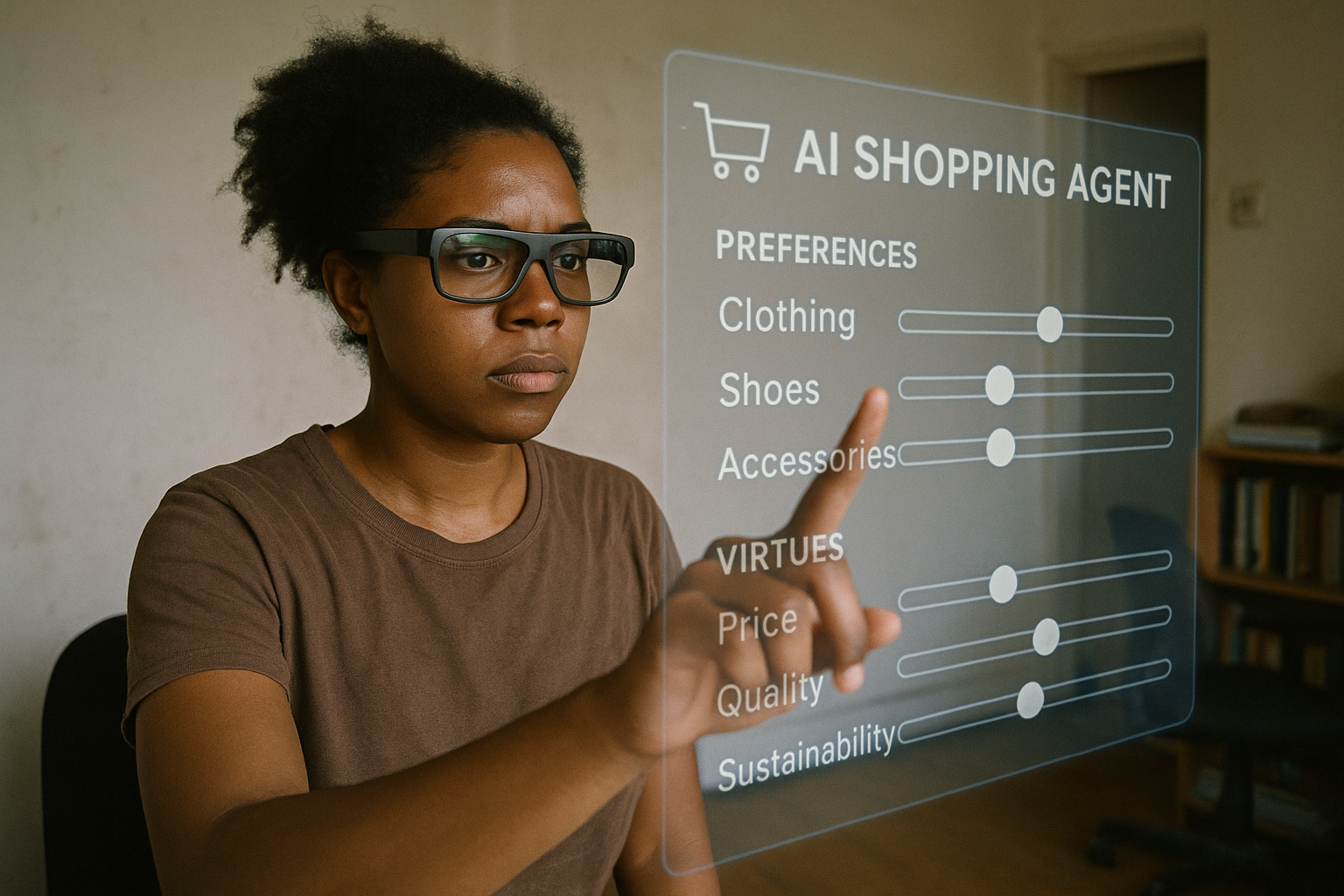
There’s a moment coming when each of us will sit down — maybe at a laptop, maybe speaking out loud into the air — and realize we’re about to design something that knows us more intimately than any partner, parent, or friend.
Our personal AI models aren’t just “assistants.” They’re reflections of us: what we value, what we fear, what we’ll tolerate, what we’ll refuse. They’ll shop, negotiate, schedule, comfort, remind, and sometimes even argue with us. They’ll learn our habits, anticipate our moods, and occasionally push back when we drift out of alignment with the goals we once set.
It’s exciting. It’s terrifying. And it’s not something we’ve ever really had to do before.
How do you build a digital self without losing the messy, contradictory parts that make you human?
Start With Boundaries, Not Features
The temptation will be to begin with features: “make it funny,” “make it fast,” “make it bargain hard.” But the healthier place to start is boundaries.
- Never buy debt products.
- Don’t share my child’s data.
- Always flag major purchases over $500.
Think of it like raising a teenager: you don’t begin by teaching advanced calculus. You begin with house rules. You lay the rails of safety first.
MIT researcher Sherry Turkle has long argued that “our technologies shape us as much as we shape them.” The same will be true here. A model raised without boundaries may shape you in ways you didn’t intend.
Memory Hygiene
Unlike us, agents don’t forget — unless we tell them to. That’s both a feature and a burden.
Imagine if every offhand comment you made was stored, replayed, and used to guide future decisions. Helpful sometimes, suffocating others.
That’s why memory hygiene will matter:
- Ritualized forgetting: A monthly “clear out” of irrelevant or outdated preferences.
- Context windows: Limiting how long casual remarks stay influential.
- Selective amnesia: Asking your agent to “forget the week I was stressed about work, don’t let it shape long-term habits.”
It’s not unlike journaling or therapy — pruning what deserves to stay part of your story and what doesn’t.
Family and Collective Modes
We don’t live alone, and neither will our agents. They’ll interact with our families, our teams, our communities. That means personal models will need modes:
- Family mode: A parent’s agent coordinates with a teenager’s agent, negotiating curfews or shared budgets.
- Team mode: A group of colleagues’ agents align on deadlines before humans meet.
- Community mode: Neighborhood agents pool resources to manage local needs.
This is where things get beautifully complicated. Your agent isn’t just you — it’s you-in-relationship. And those relationships will test what you value more: efficiency, fairness, or harmony.
Sociologist danah boyd once wrote: “Technology doesn’t just change what we do. It changes how we do things together.” The personal model will be no different.
The Emotional Mirror
We need to admit something: our agents will know us emotionally, sometimes better than we do.
They’ll spot the pattern that every time your pulse rises and your browsing drifts to late-night shopping, you’re stressed. They’ll gently delay purchases, or suggest sleep, or cue calming music.
Helpful? Absolutely. But also invasive. Because when your agent intervenes on your behalf, it’s not just doing tasks. It’s interpreting you.
Psychologist Adam Grant suggests reframing: “We should design systems not to control us, but to coach us — nudging toward our best selves, not our most efficient selves.”
That’s a hopeful framing. But it requires humility in design: agents must know when to step back, not just when to step in.
The Problem of Taste
One of the strangest questions is whether your agent will cultivate your taste — or replace it.
If your model keeps refining your music playlists, wine choices, or fashion style, at what point are you developing taste versus outsourcing it?
Philosopher Bernard Stiegler argued that technology always externalizes memory and culture — the risk is forgetting to re-internalize it.
Maybe the solution is to make space for “exploration mode”: your agent intentionally surfaces options outside your pattern. Not because they’re efficient, but because they’re different. Taste, after all, is partly about surprise.
Transparency and Trust
Above all, personal models must earn and sustain trust. That doesn’t mean perfection — it means clarity.
- Why did you recommend this? → answered in plain language.
- What data did you use? → cited, with provenance.
- What tradeoff did you make? → logged, so you can agree or disagree.
Without this transparency, trust fractures quickly. And trust is the whole point.
As one OpenAI researcher put it in a recent panel: “If your agent doesn’t feel like it’s on your side, it’s just another platform. The relationship is the product.”

Everyday Futures
It helps to imagine some lived futures:
- A mother configures her agent never to accept manipulative upsells — and feels peace knowing it won’t cave at midnight.
- A freelance designer teaches her agent to forget abandoned drafts, so her current style isn’t haunted by past experiments.
- A retiree configures his agent to flag any financial decision over $1,000 for human review — keeping independence, but adding a layer of safety.
None of these are about efficiency. They’re about dignity.
The Optimistic Spin
If we do this right, personal models won’t flatten us into predictable patterns. They’ll free us from the noise, while still leaving space for the irrational, the surprising, the emotional.
They could help us become more intentional — not less human.
But it will take design discipline: setting boundaries, practicing memory hygiene, building collective modes, demanding transparency.
Looking Forward
Designing a personal model isn’t like setting up a new phone. It’s closer to writing a constitution. You’re not just choosing features — you’re deciding what kind of self you want mirrored, what kind of relationships you want honored, what kind of future you want nudged toward.
That’s daunting. It’s also an invitation.
Because if we can learn to shape these models with care, we may find ourselves not diminished by them, but clarified. Not reduced, but expanded.
The personal model is not the end of our agency. It’s the next test of how much of our humanity we’re willing to carry into the systems that increasingly act on our behalf.
And maybe, if we’re deliberate, it will be the tool that gives us back what no machine can invent: time, trust, and the freedom to keep becoming ourselves.
Leave a Reply