
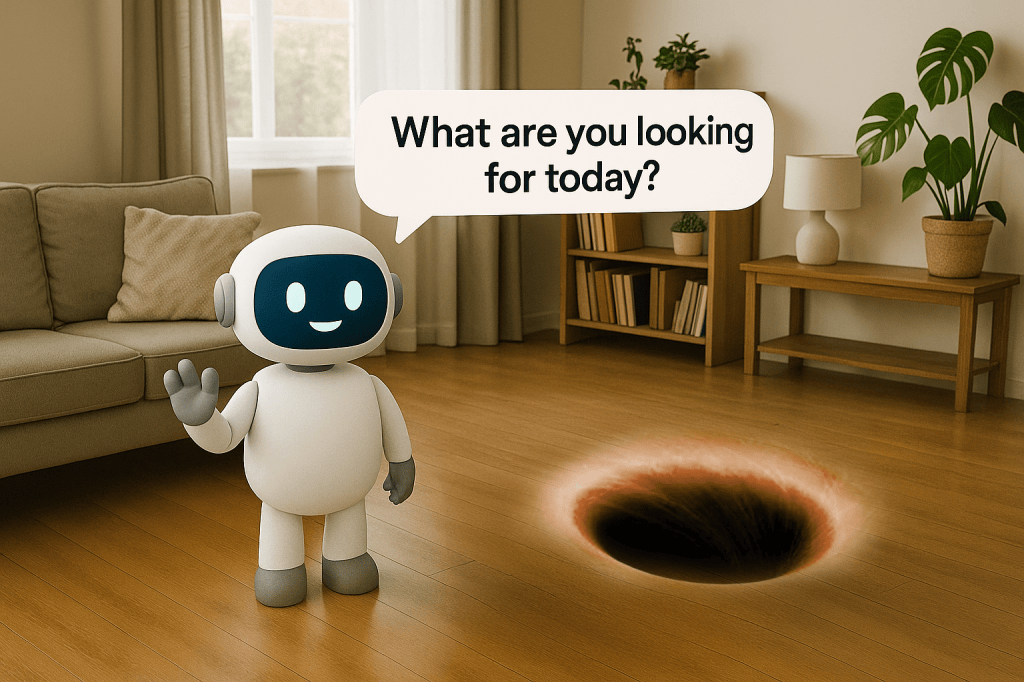
For more than a century, sales has been built on the metaphor of the funnel. Start with awareness at the top, nurture leads down the middle, close deals at the bottom. Every CRM system, every marketing campaign, every sales compensation plan has been shaped by that linear journey.
But the funnel doesn’t map onto the agentic economy. When your personal AI negotiates directly with a brand’s AI, there’s no clean line from awareness to conversion. Instead, sales becomes a dialogue — ongoing, adaptive, and three-way. It’s your agent, the company’s agent, and you, orbiting one another in a long-running conversation.
That shift breaks the funnel. And it forces businesses to rethink how they design, measure, and practice sales.
Why Funnels Fail in an Agentic World
The funnel assumes:
- Humans do the searching (awareness).
- Humans compare and consider (evaluation).
- Humans make the final call (conversion).
Agents collapse those steps. Your agent already knows your needs, your constraints, your preferences. It shortlists and negotiates before you’re even aware of the options.
A 2024 McKinsey study projected that by 2030, over 70% of B2C transactions will involve at least partial agent mediation. In other words, most customers will never “enter” a funnel at all. They’ll enter a dialogue where their agent is already halfway through the journey.
“Funnels are for people,” said Forrester analyst Mary Shea. “Agents operate in loops. They don’t forget, they don’t reset, and they don’t move sequentially. They converse.”
Conversations, Not Campaigns
So what does a dialogue-based sales process look like?
- Persistent Memory: Agents don’t start from zero. They recall past negotiations, loyalty history, even tone.
- Continuous Coaching: Sales agents don’t just close once — they mentor your personal agent through product use, upselling later by proving ongoing value.
- Adaptive Personas: The company’s agent presents differently depending on context: technical detail for a customer’s “engineer agent,” emotional reassurance for a “family budget agent.”
Instead of a funnel, picture a spiral. Customers and brands circle one another through ongoing conversations, punctuated by purchases but never ending with them.
Metrics That Actually Matter
Funnels gave us familiar metrics: cost per lead, MQLs, conversion rates. Those collapse in dialogue-driven sales.
New metrics may include:
- Conversation P&L: measuring the lifetime value of a single ongoing dialogue thread.
- Resolution Ratio: how often an agent conversation ends without human escalation.
- Trust Index: whether a personal agent re-engages with a brand’s agent after a purchase.
“Sales will shift from transactions to relationships measured in persistence,” argued Brent Adamson, co-author of The Challenger Sale. “The question isn’t ‘did you close?’ but ‘did you stay in dialogue?’”
Risks in the Dialogue Economy
Of course, conversations can go wrong:
- Manipulative Coaching: corporate agents nudging personal agents toward upsells under the guise of “mentorship.”
- Dialogue Fatigue: customers overwhelmed by too many background interactions they never see.
- Opaque Loops: agents negotiating endlessly without the human knowing what’s being promised.
Regulators are already warning here. The UK’s CMA flagged “persistent influence” as a potential consumer harm — when automated systems continue nudging without consent.
Businesses that treat dialogue as a covert funnel will face backlash.
The Optimistic Angle
Handled well, dialogues can make sales feel more human, not less.
- Imagine a home fitness brand whose agent coaches your agent through safe training plans, only later suggesting upgraded equipment.
- Or a travel brand whose agent checks in months after a trip, asking if you’d like similar destinations, instead of blasting generic emails.
- Or a bank agent that genuinely advises your agent against overspending, preserving trust instead of pushing credit.
In these cases, sales becomes a long conversation about value — not a funnel that pressures a one-time “yes.”

Everyday Ripples
The dialogue model changes daily life in subtle ways:
- A freelancer’s agent maintains an ongoing thread with a software vendor’s agent, negotiating renewals and offering feedback continuously.
- A parent’s agent keeps in touch with a grocery chain’s agent, adjusting weekly orders around dietary changes.
- A teenager’s agent chats with a clothing brand’s agent over months, tracking trends and recommending when to buy at a discount.
Each of these interactions looks less like a funnel, more like a relationship — sometimes even like friendship.
Looking Forward
The sales funnel was a map for a world where humans did the work of searching, comparing, and choosing. Agents erase that map. They create a terrain of ongoing, adaptive dialogue, where trust and persistence matter more than reach and conversion.
That’s not a loss. It’s a chance to rebuild sales around conversations that actually serve people.
The companies that thrive won’t be the ones who cling to funnels. They’ll be the ones who master dialogue — teaching their agents not to push harder, but to stay present, patient, and useful.
Because in the agentic economy, the sale isn’t the end of the journey. It’s just another turn in the conversation.


Leave a Reply