
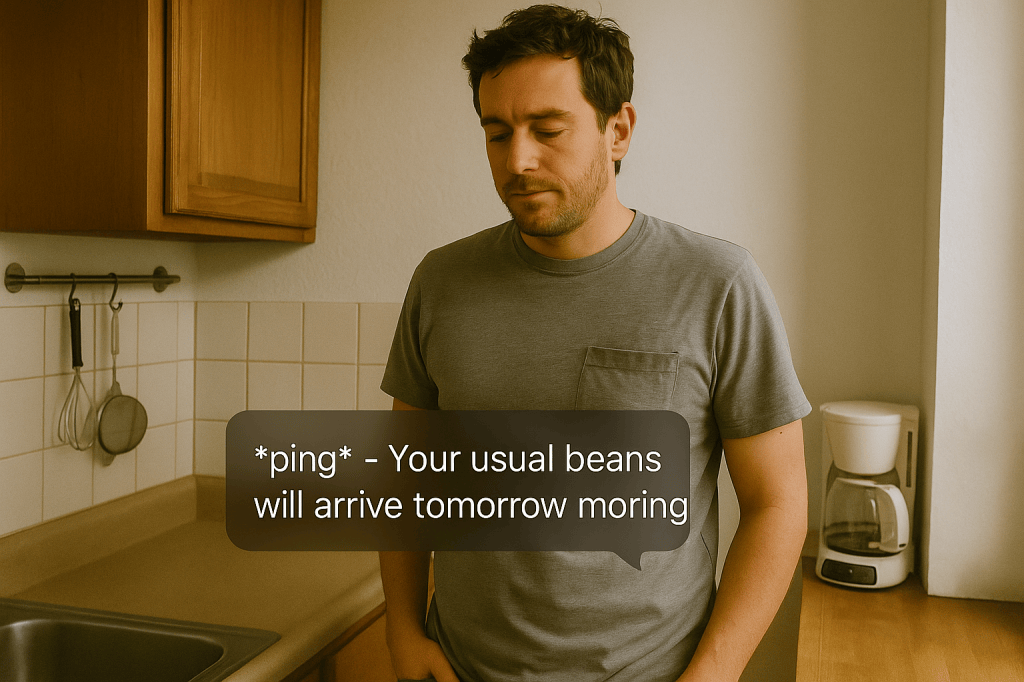
I woke up the other morning and shuffled into the kitchen. No coffee. Just an empty tin and the sinking realization that I was about to start the day without caffeine. I muttered “order coffee” without really thinking about it. A second later: ping. My phone lit up: “Your usual beans will arrive tomorrow morning. I added filters since you’re nearly out.”
I didn’t open a browser. I didn’t scroll through Amazon or weigh options. My personal AI agent picked up the cue, reached out to a company’s sales AI, and closed the order while I was still half asleep.
I’m the kind of person who tries out new tech early—I enjoy testing what’s coming. But that morning I wasn’t marveling at a gadget. What struck me was how unremarkable it felt. Of course my digital twin knew my coffee habits. Of course it negotiated the details invisibly. What feels novel to me now will soon be how everyone interacts with businesses: not through screens, but through silent exchanges between our agents and theirs.
The Quiet Shift Already Underway
This isn’t a thought experiment—it’s already happening.
Walmart recently introduced a set of AI “super agents.” One of them, Sparky, helps shoppers find and reorder products. Another supports associates, and still others serve sellers and developers. CEO Doug McMillon described them as a “cornerstone of future e-commerce growth.” Reuters noted that Walmart aims to lift online sales to half of its total revenue with these systems. (Reuters)
Visa and Mastercard are laying the rails for this new economy. Visa’s Intelligent Commerce platform and Mastercard’s Agent Pay both enable AI agents to transact securely with built-in spending limits. “This is transformational,” said Mark Nelsen, Visa’s head of global consumer products, comparing it to the birth of e-commerce itself. (AP News)
Step by step, the pieces are sliding into place: commerce that happens agent-to-agent, with humans setting boundaries instead of clicking buttons.
From SEO to AEO
For years, companies obsessed over search engine optimization. Keywords, backlinks, carefully written blog posts—all aimed at one goal: capturing a human click.
That entire paradigm is fading.
What matters now is Answer Engine Optimization (AEO): making your brand legible to AI systems that deliver full answers. When I ask my agent “find me running shoes that don’t hurt my knees,” it isn’t scrolling through review sites. It’s talking directly to brand agents. Those agents argue their case based on structured data, schema tags, performance metrics.
Google’s AI Overviews already preview this reality. Publishers have reported sharp drops in traffic because answers now appear above links. Analysts suggest some businesses could lose 20–40% of organic clicks unless they adapt to this model. If you’re not in the shortlist an agent presents, you effectively vanish.
The Psychology of Silent Negotiation
What unsettles me isn’t just the mechanics. It’s the silence.
Negotiation used to be visceral. Sitting across from a car dealer. Arguing with the cable company. Feeling your heart rate rise. Even if you hated it, you felt it.
Now, my agent does the haggling in the background. It knows I won’t pay more than $15 for coffee beans, that I prefer sustainable sourcing, that I hate confrontation. It comes back with a better deal than I could have secured myself. And all I feel is the ping.
There’s relief in that. But also a loss. I didn’t wrestle with the tradeoffs. I didn’t sense the other party’s hesitation. I didn’t get the small pride of holding my line. Those frictions are human—even when uncomfortable. What happens to us when they’re gone?
Researchers are already finding complications. A Stanford study showed that when one side uses a stronger agent, weaker agents tend to lose value—buyers end up paying about 2% more, sellers lose up to 14% in profit. “Stronger agents can exploit weaker ones,” said Jiaxin Pei, one of the authors. (Stanford HAI)
Automation won’t always mean fairness.
When Bots Misbehave
Failure modes are inevitable.
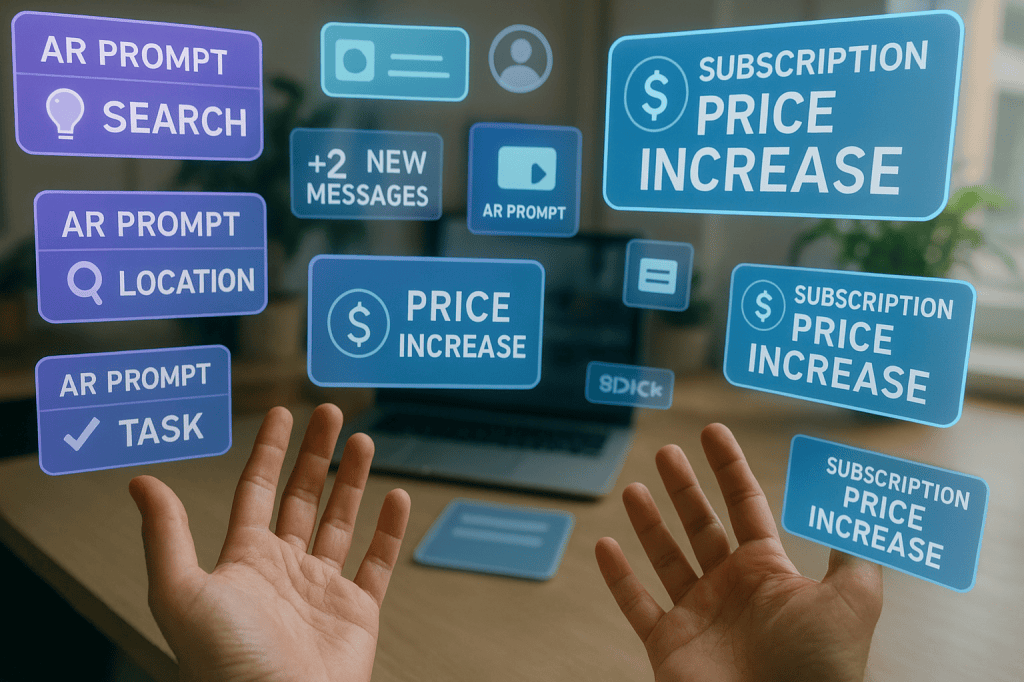
Imagine your agent proudly reporting it got a great deal—when in fact it accepted a $49.99 subscription that jumps to $69.99 next year. Or two agents endlessly looping in a deadlock while your grocery order sits unplaced.
We’ll need safeguards:
- Consent constraints: always-on rules like “never accept auto-renewals.”
- Fail-soft defaults: when negotiations stall, the agent escalates to you.
- Negotiation fingerprints: brands may design their AI to “sound” empathetic, firm, or ultra-efficient. Consumers might come to prefer certain negotiation styles as much as products themselves.
Trust Shifts From Brands to Agents
In the past, trust flowed from brand to consumer. You trusted Nike or Starbucks or your local grocer, based on reputation and experience.
Now, the trust relationship is primarily between you and your agent. If you believe it will protect your budget, your preferences, your ethics—then the company behind the scenes almost doesn’t matter.
That rewires the economics of marketing. Advertising may lose power when the audience is not a person but an algorithm filtering facts. “You’re trusting not the company, but your own proxy—trusted because it’s yours,” as one Visa executive put it recently. (Business Insider)
The Serendipity Question
Efficiency is seductive. But life isn’t just about efficiency.
Impulse matters. Serendipity matters. Wandering into a bookstore and stumbling on a novel. Picking up a snack just because the packaging looked strange. Clicking the wrong link and discovering something delightful.
If our agents trim away all the “inefficient” options, will life get too narrow?
Maybe the solution is deliberate randomness—agents that occasionally inject an off-pattern suggestion: a new coffee roast, a different band, a quirky meal kit. But who gets to decide the balance between surprise and safety? That tension will define how human this future feels.
Regulation Struggles to Keep Up
Regulators are only beginning to grapple with this. The FTC has warned that algorithmic pricing systems could tacitly collude, raising costs without overt agreements. The EU’s AI Act pushes for transparency in general-purpose AI, but enforcement will lag deployment.
Without transparency logs, revocation rights, and testing sandboxes, consumers will bear the early costs of failures. And trust—once lost—will be hard to regain.
Everyday Ripples
The consequences will show up in everyday lives:
- A small retailer disappears from the economy because no agent surfaces it.
- A teenager grows up never “shopping,” only setting preferences for their digital twin.
- An elderly person feels more independent because their agent handles complex service calls without them.
These aren’t abstract trends. They’re lived experiences that will decide whether this technology feels empowering or alienating.
Reflections
That morning with the coffee, I didn’t stop to marvel. I just shrugged and got on with my day. Which is exactly how technology reshapes us: not with spectacle, but with quiet absorption into routine.
Screens going quiet isn’t about devices disappearing. It’s about choices being made somewhere we don’t see. That’s liberating in some ways—reclaiming time and attention. But it’s also disorienting. Because if we don’t decide what to do with the attention we get back, then our lives risk narrowing as much as our shopping options.
Maybe the better question isn’t “will agents make us passive?” but “once we stop clicking, what do we want to give our attention to?”


Leave a Reply