
One of the most frustrating days I’ve had this year started with a call to my internet provider. You probably know the drill: hold music looping forever, menus that don’t quite fit your problem, a rep who finally arrives and reads a script that doesn’t really answer your question. By the end, I wasn’t just annoyed at the company — I was drained, like I’d burned an afternoon arguing with a wall.
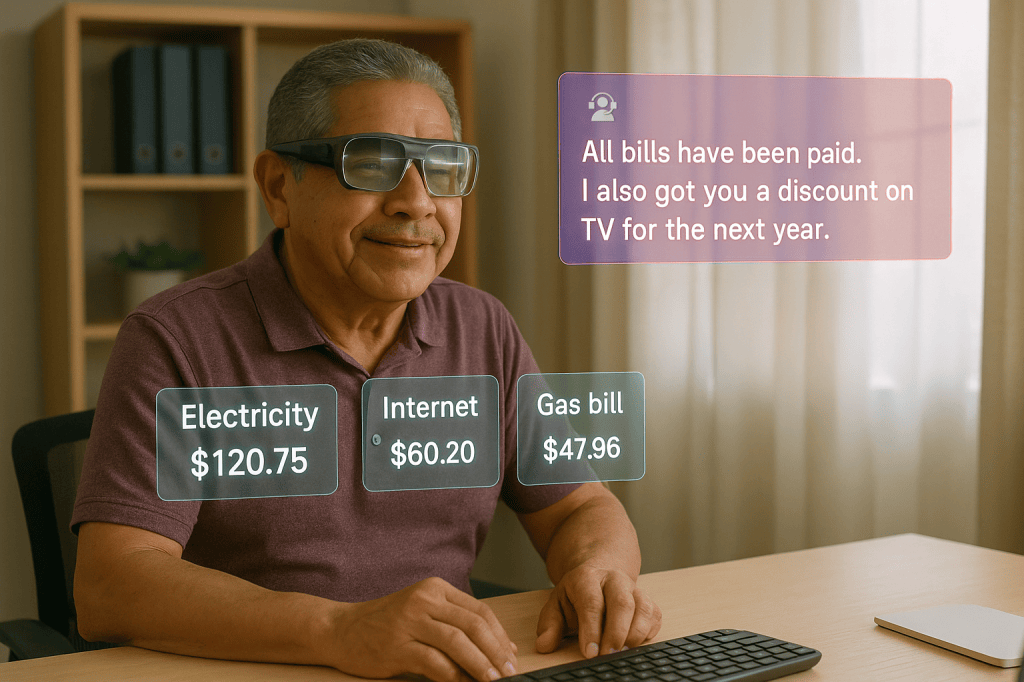
Now imagine a different version. My personal AI agent calls their service agent. It knows the context: I was overcharged $40, I’ve been a loyal customer for five years, and I don’t want to wait on hold. Their AI knows the company’s policies, constraints, and offers. The two agents hash it out — fast, polite, unemotional. Minutes later, my phone buzzes: “Refund of $40 approved. Credit will appear in 2–3 days.”
I never sat on hold. I never repeated my account number. I never lost my afternoon.
That’s where we’re headed: customer service without customers.
The End of the Call Center as We Know It
Customer service has always been a human bottleneck. Companies spend billions on call centers. Employees bear the stress of angry voices. Customers burn hours in queues.
The shift to agent-to-agent service could rewrite that equation. Gartner predicts that by 2030, over 80% of routine service interactions will happen agent-to-agent, with no human in the loop unless something unusual arises.
And there’s reason for optimism:
- Faster: machines don’t keep you waiting.
- Fairer: an agent can document your history precisely.
- More accessible: for people with disabilities, language barriers, or anxiety, the relief is profound.
McKinsey estimates that automation in service could save U.S. companies $400 billion annually. But the real gain isn’t just money. It’s dignity.
A Case in Point: Airlines and Refunds
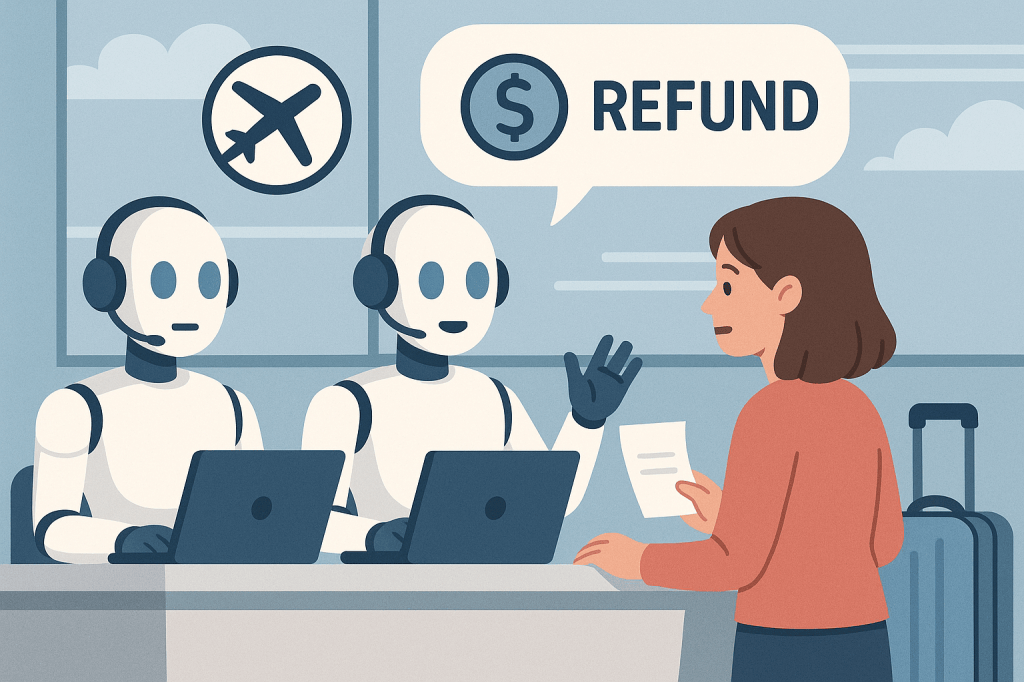
Airlines are an easy example. Refunds, vouchers, seat changes — they follow predictable rules. Today, humans mediate those rules with varying empathy and patience. Tomorrow, agents will do it directly.
In 2023, a major European carrier tested an “agent handshake” system: customers could authorize their own AI to negotiate upgrades. The airline’s AI factored loyalty status, seat maps, and weather delays. Results were striking: resolution times dropped from 22 minutes to under 2. And both sides reported fewer escalations.
It wasn’t perfect — one customer complained their agent “agreed too fast” and left perks on the table. But it was a glimpse of what’s possible.
Expert View: The Emotional Gap
“Automation has to be more than efficiency,” says Dr. Stefania Milan, professor of digital culture at the University of Amsterdam. “Service is emotional. People want to feel heard. If agents replace humans entirely, companies risk erasing empathy from the equation.”
That’s the crux: how do we preserve care in a system designed for speed?
Bot SLAs and Agent Etiquette
One answer may be new kinds of service standards — Bot SLAs (service-level agreements for agents). These could cover:
- Response time: instant is expected.
- Politeness: no adversarial scripts, even bot-to-bot.
- Escalation dignity: if anger or confusion spikes, humans step in seamlessly.
Agent etiquette may become a brand differentiator. Just as we once judged a company by the warmth of its call reps, tomorrow we may judge by how its agents “treat” our agents.
The Small Business Question
There’s a hopeful side here for small businesses. Today, many can’t afford 24/7 support staff. But agent-to-agent protocols could level the field: a bakery’s AI could handle catering requests at midnight just as smoothly as a Fortune 500.
But there’s also a risk: if integration standards are set by a few big players, smaller businesses may be excluded. Access to the service layer may itself become a new gatekeeping battle.
Optimism with Guardrails
I find myself cautious but hopeful. For every story of hold-music purgatory, there’s a chance to give people their time back. For every exhausted rep leaving a call center job, there’s a chance to redirect that labor into roles that require genuine empathy, not rote policy recitation.
Still, there are unknowns:
- Will consumers trust their agents to fight for them?
- Will companies design fair bots, or manipulative ones?
- Will escalation always remain an option, or will humans be locked out?
As AI ethicist Abeba Birhane puts it: “Delegation isn’t abdication. We need to design systems where agency flows back to the human, not away from them.”
Everyday Ripples
Picture a few lives touched by this shift:
- A working parent finally resolves a billing error in seconds, not hours.
- An immigrant negotiates service in their native language without fear of being misunderstood.
- An older adult feels more confident in managing utilities, because their agent handles the complex policy speak.
These are small stories, but they add up to something larger: time and dignity restored.
Looking Ahead
Customer service has always been a drain — on customers, on workers, on patience itself. Agent-to-agent systems won’t solve everything, and they’ll raise new risks. But they hold a promise worth pursuing: a world where we spend less time fighting companies and more time living.
It won’t be perfect. Some interactions need human warmth. Some escalations will fail. Some manipulations will slip through.
But if we get it right, “customer service without customers” could mean something profoundly positive: service that respects us enough to stop wasting our time.


Leave a Reply