
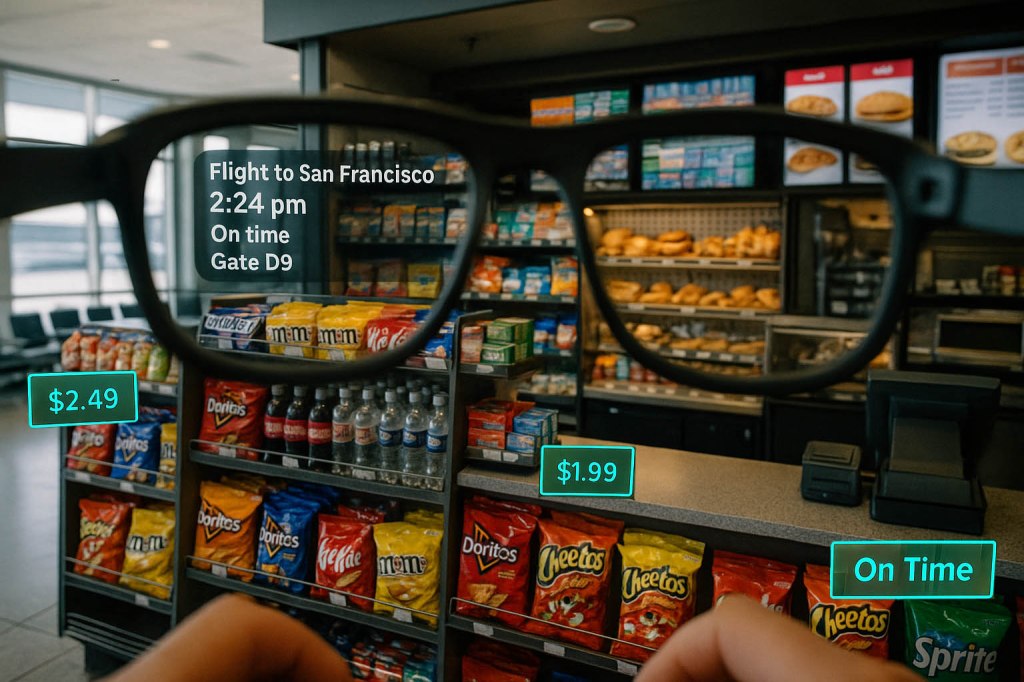
Walking through the airport, I noticed a small cluster of people wearing Meta’s AR glasses. They weren’t staring down at phones. They weren’t swiping. They were just… looking. One guy glanced at a snack display, murmured something, and a moment later smiled like he had the answer he wanted.
That moment struck me. We’re on the edge of a world where the screen isn’t the medium anymore. Instead of typing queries, we’ll simply see things — and the answers, the prices, the recommendations will appear, not as links or search results, but as whispers in our periphery.
For decades, commerce has been about pulling our eyes down into glowing rectangles. But the next phase is about looking up. AR glasses and voice-driven agents will collapse the distance between noticing and knowing.
The Hardware Is Finally Catching Up
Meta has sold more than a million pairs of its Ray-Ban glasses since 2023. Mark Zuckerberg called them “the first mainstream smart glasses” and claimed demand was ahead of projections. (The Verge)
Why now? The earlier generations of AR — Google Glass, Microsoft HoloLens — were bulky, expensive, and socially awkward. The new wave is different: lightweight frames, longer battery life, and seamless integration with voice-driven AI. Meta’s glasses can translate signs, identify products, and even give live commentary on what you’re seeing.
Apple’s Vision Pro has a different approach — heavier, immersive, more for productivity and media. But the direction is clear: the hardware is improving fast enough that we can imagine living in it, not just demoing it.
From Browsing to Being Shown
Think about how shopping worked online. You typed “best winter jackets.” You scrolled. You compared. You clicked. That ritual was about search.
But with glasses, it flips. You look at a jacket in a store window, and your agent whispers: “That’s the Patagonia Nano Puff, $229. Your size is in stock two blocks away. There’s a 20% discount if you order online.”
The browsing is gone. You’re not searching. You’re being shown.
As NYU marketing professor Scott Galloway put it: “Attention is moving from thumbs to eyes. The battle isn’t for clicks anymore, it’s for presence.”
The New Rules of Design
This shift creates new design challenges:
- Glance-Length Interactions: Information has to be digestible in under two seconds. No long product pages. Just enough to nudge a decision.
- Context First: The system knows your location, your past behavior, even your pulse. Recommendations are shaped by where you are and how you feel.
- Voice + Vision Fusion: You’ll often confirm with a whisper — “yes, buy it” — rather than a tap. Interfaces shrink down to the most natural gestures.
It’s less like browsing a catalog and more like having a companion who notices alongside you.
Privacy in the Periphery
Of course, there’s a dark side. If cameras and mics are always on, who else is listening?
Civil liberties groups have raised concerns about Meta’s glasses recording in public spaces. Shoppers may not know when they’re being scanned for object recognition. In one test, users reported unease when strangers’ outfits were identified and described in real time.
“There’s no off switch for being perceived,” said privacy scholar Shoshana Zuboff. “When commerce enters the line of sight, every glance becomes a data point.”
For companies, the temptation is obvious: intercept attention at the moment of perception. For consumers, the cost may be invisible surveillance.
How Businesses Are Preparing
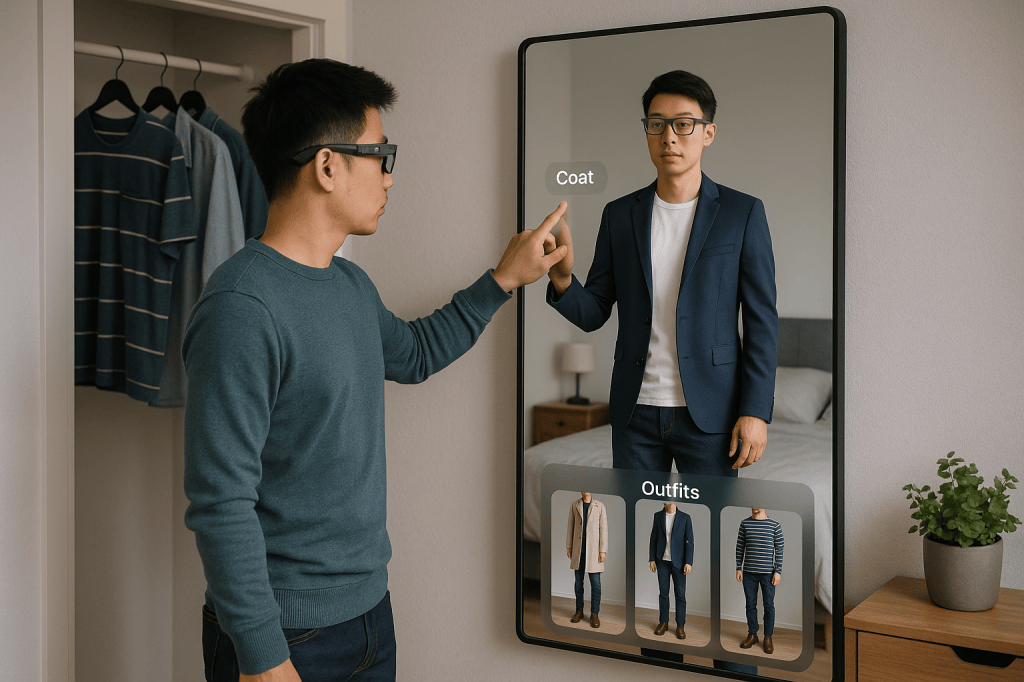
Retailers are already experimenting with AR-driven commerce:
- IKEA lets customers preview furniture in their rooms using AR, bridging in-store and online experiences.
- Amazon has tested AR try-ons for shoes and accessories, layering them over a live camera view.
- Nike acquired an AR startup to help shoppers measure feet instantly in-store or at home.
But with agent-driven glasses, the game changes again. Businesses won’t just show products in AR apps; they’ll compete to have their information surfaced at the moment you look.
This will make product data infrastructure critical. If your item isn’t tagged, structured, and accessible, your brand may literally not exist in the consumer’s gaze.
A New Kind of Impulse
Impulse buying is emotional. You see candy at checkout, you grab it. In a screen world, brands engineered digital equivalents — pop-ups, flash sales, social ads.
But AR impulse is different. It’s contextual and fluid:
- A nudge when you glance at a shoe.
- A suggestion when you pause too long on a bottle of wine.
- A recommendation tailored to your budget constraints, delivered with zero friction.
Psychologists warn this may be even more persuasive than traditional ads. “You’re catching people at the edge of desire,” said behavioral scientist Katy Milkman. “And now the agent can act instantly on that spark.”
Serendipity or Funnel?
One worry is that glasses narrow experience. If your agent is filtering the world, you may never see beyond what it thinks you want. You might glance at three restaurants, but your AI only highlights the one with the best loyalty partnership.
The risk is a kind of invisible funnel: the world feels open, but your options are quietly pre-sorted.
Designers argue we’ll need deliberate injections of randomness — moments when agents show us something unexpected, just to keep the world surprising. Otherwise, the texture of chance encounters could be lost.
The Social Layer
There’s also the question of etiquette. When Google Glass launched in 2013, “Glassholes” became a meme. People resented the idea of being recorded.
Meta’s glasses may avoid some of that stigma by looking ordinary, but the underlying challenge remains. What does it mean to live in a world where you can no longer tell if someone is “in the moment” with you, or quietly checking the price of your shoes?
Sociologist danah boyd calls this “ambient distraction.” “We’re moving into an era where attention isn’t just scarce, it’s opaque. You’ll never know what someone is seeing while you talk to them.”
Regulation on the Horizon
Already, cities like San Francisco have floated restrictions on constant-recording glasses. The EU has pushed for “recording indicators” — lights that signal when devices are capturing. Meta has complied with small LED signals, but critics argue they’re too subtle to matter.
Expect more battles here. Just as laws had to adapt to smartphones in classrooms, driving, and workplaces, AR glasses will spark new debates over when and where they’re acceptable.
Everyday Stories
It’s one thing to analyze trends. It’s another to imagine lives:
- A teenager walking through a mall, glancing at sneakers, and hearing their agent negotiate a discount in real time.
- A parent in the grocery store, scanning produce, while their agent checks freshness data and reminds them of dietary restrictions.
- An older adult feeling more independent because they can look at a bus stop sign and hear instant directions, without fumbling for a phone.
Each of these is a human story about presence, convenience, and the blurred line between seeing and buying.
Looking Ahead
When I first saw those people at the airport in Meta glasses, I realized how quickly this will normalize. Ten years ago, someone staring at their phone looked odd. Now it’s background noise. In a few years, glancing and murmuring into glasses will feel the same.
The front door to commerce is moving again — from search boxes, to AI answers, to the edge of our vision. Businesses will adapt. Regulators will scramble. But for the rest of us, the bigger question is more personal:
When the world itself becomes annotated, what do we want to pay attention to? And how do we keep seeing each other — not just the data layered on top?


Leave a Reply