
Executive Summary: Why This Guide Exists
AI adoption fails less often because models are “not smart enough,” and more often because organisations adopt without operating models: unclear ownership, unclear constraints, no evidence trail, and no definition of “safe to ship.”
This guide is a practical playbook for adopting AI in a way that is measurable, governable, and aligned with business outcomes. It is written for teams who want value without chaos.
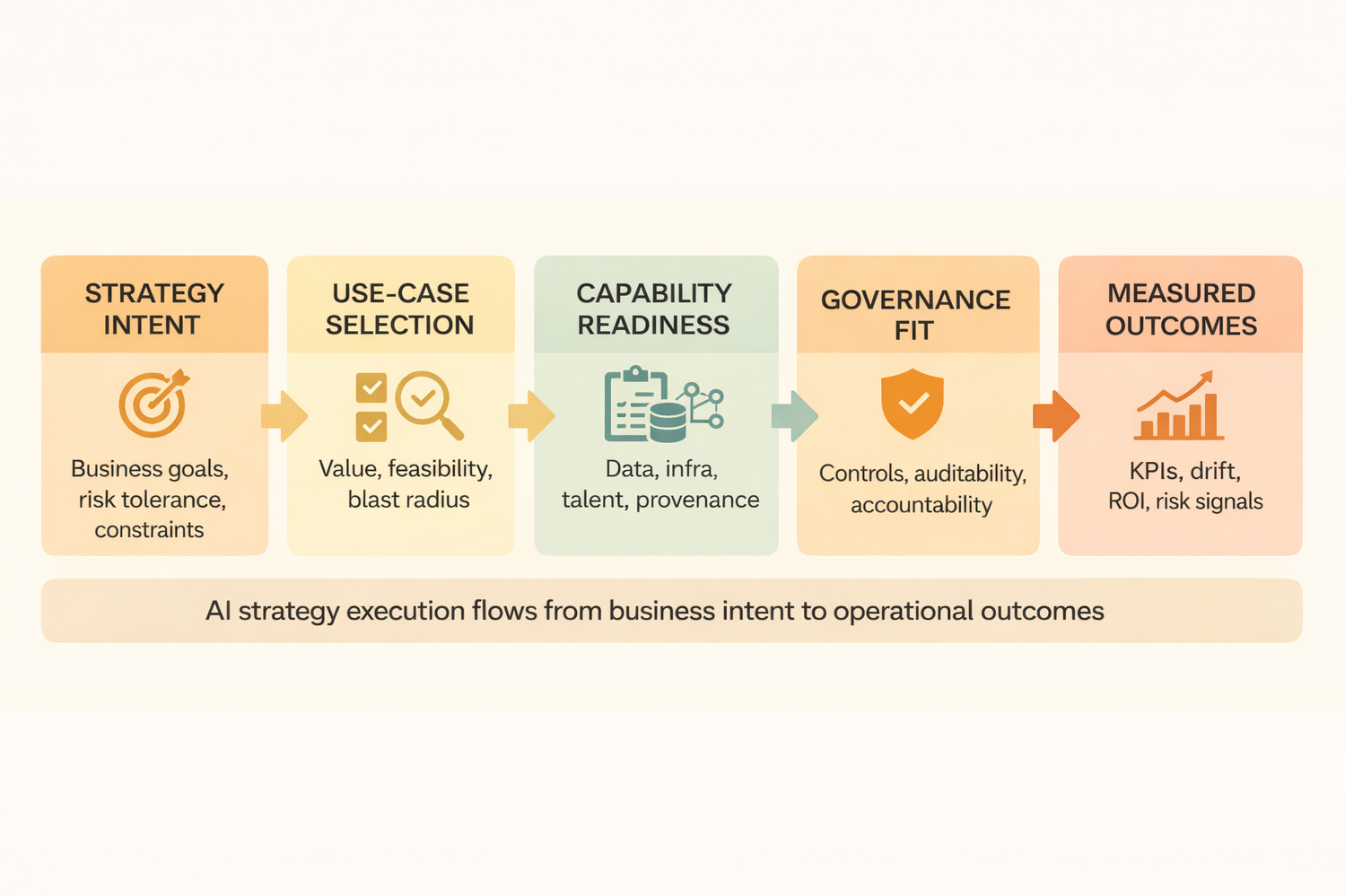
How to use this guide
- Start at the top if you are defining or revisiting AI strategy at an organisational level.
- Jump to decision gates if you are evaluating or prioritising specific AI use cases.
- Pair with the Governance Field Guide once systems move from planning into execution.
This guide is designed to be read non-linearly, depending on where you are in your AI adoption journey.
What You Are Actually Deploying
Before procurement, define which category your use case falls into:
- Content generation (marketing, drafting, ideation)
- Knowledge assistance (search, summarisation, Q&A)
- Decision support (recommendations, triage, prioritisation)
- Automation (end-to-end workflows, tool execution)
Treat these as different risk classes. The governance, evidence requirements, and human oversight are not the same.
Details: Common adoption mistake
Teams buy a “platform” before defining the job. The platform then dictates the workflow, rather than the workflow dictating the architecture.
The Adoption Operating Model
A sustainable program needs explicit ownership across five roles:
- Business owner (value + acceptance criteria)
- Product owner (workflow design + rollout)
- Engineering owner (architecture + reliability)
- Risk/Compliance owner (controls + documentation)
- Model owner (evaluation + drift monitoring)
If your organisation cannot name these owners, it is not ready to scale beyond pilots.
Details: Minimum governance cadence
Weekly: incidents + drift signals
Monthly: evaluation review + policy changes
Quarterly: control audit + vendor review
Procurement That Doesn’t Get You Trapped
Procurement should not ask “is it accurate?” It should ask:
- What evidence trail is produced for outputs?
- Can we inspect sources, policies, and failure states?
- Can we export logs and evaluation results?
- How does the system behave when it cannot justify an answer?
- What happens when data changes (drift)?
Details: What to require in vendor demos
Require two demos:
- a “happy path” use case
- a “failure path” use case (missing evidence, contradictory sources, policy conflict)
The Three-Phase Rollout
Phase 1 — Pilot (learn the workflow)
- narrow scope
- explicit human review
- basic evaluation baseline
Phase 2 — Gated Production (prove stability)
- defined refusal behaviour
- evidence trail requirements
- monitoring and incident response
Phase 3 — Scale (repeatable controls)
- SOPs
- training
- periodic audits
- drift review
Details: The rollout rule
Do not scale a system that cannot explain its own outputs.
Human-in-the-Loop That Actually Works
Human review is not “someone checks it sometimes.” It is a designed system:
- what decisions require approval
- who approves
- what evidence they must see
- how disagreements are resolved
- how decisions are logged
If humans are in the loop, the loop must be measurable.
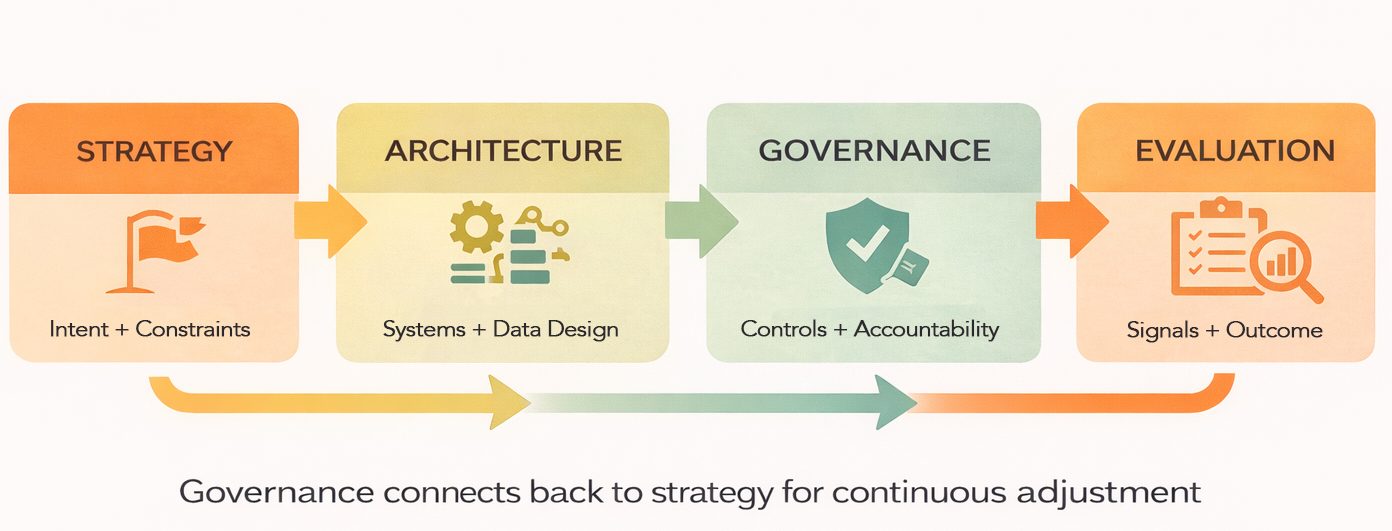
What “Good” Looks Like
A mature program can answer:
- What the system is allowed to do
- What it is not allowed to do
- What it used to produce an answer
- What checks were applied
- What happens when it cannot justify a response
- How we detect drift over time
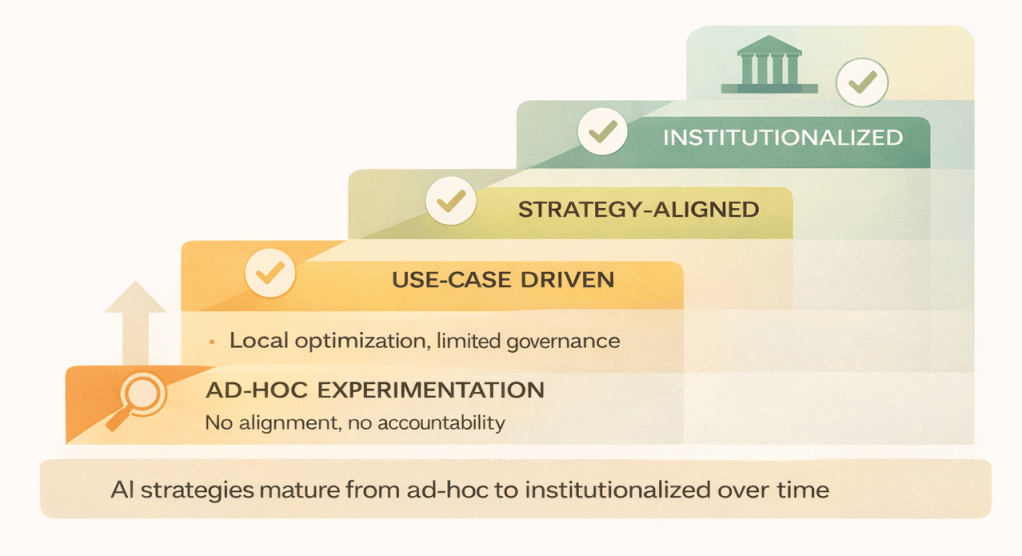
Strategy maturity is not binary
AI strategy does not appear fully formed. Most organisations operate across multiple levels of maturity at the same time — experimenting in some areas, operationalising in others, and institutionalising only a small subset of decisions.
Early efforts often focus on isolated use cases or tools. Over time, strategy becomes less about individual deployments and more about repeatable decision-making: which problems are appropriate for AI, under what conditions, with what constraints, and with what forms of accountability.
Mature AI strategy is not defined by scale or sophistication of models. It is defined by whether strategic choices can be made consistently, governed explicitly, and evaluated over time. The progression below reflects how AI strategy typically evolves as organizations move from experimentation toward institutional capability.
If you want a measurable view of maturity, take the AI Adoption Readiness Questionnaire. You’ll get a score, recommended next steps, and the minimal controls to implement before scaling.
Related Questionnaires
These questionnaires are designed to be used alongside this field guide. Each one tests whether the concepts discussed here exist in practice — across strategy, intake, engineering, governance, and operations.
Strategy & Alignment
Use-Case Intake & Risk Decisions
Build, Reliability & Grounding
-
AI Engineering Maturity (Systems)Assesses whether AI systems are production-ready, including evaluation, monitoring, drift handling, and operational reliability.
-
RAG & Grounding ReadinessUsed by teams building retrieval-augmented systems to assess evidence handling, source control, grounding quality, and traceability.
Governance, Procurement & Oversight
-
AI Governance & Compliance ReadinessUsed by legal, risk, compliance, and policy teams to assess enforceable controls, auditability, and accountability structures.
-
AI Vendor Procurement & Due DiligenceUsed before purchasing or renewing AI tools to assess evidence access, failure transparency, exportability, and vendor risk posture.
Operations & Incident Review
These questionnaires are most effective when completed by multiple roles (e.g., executive, engineering, governance) and compared for alignment gaps.

