
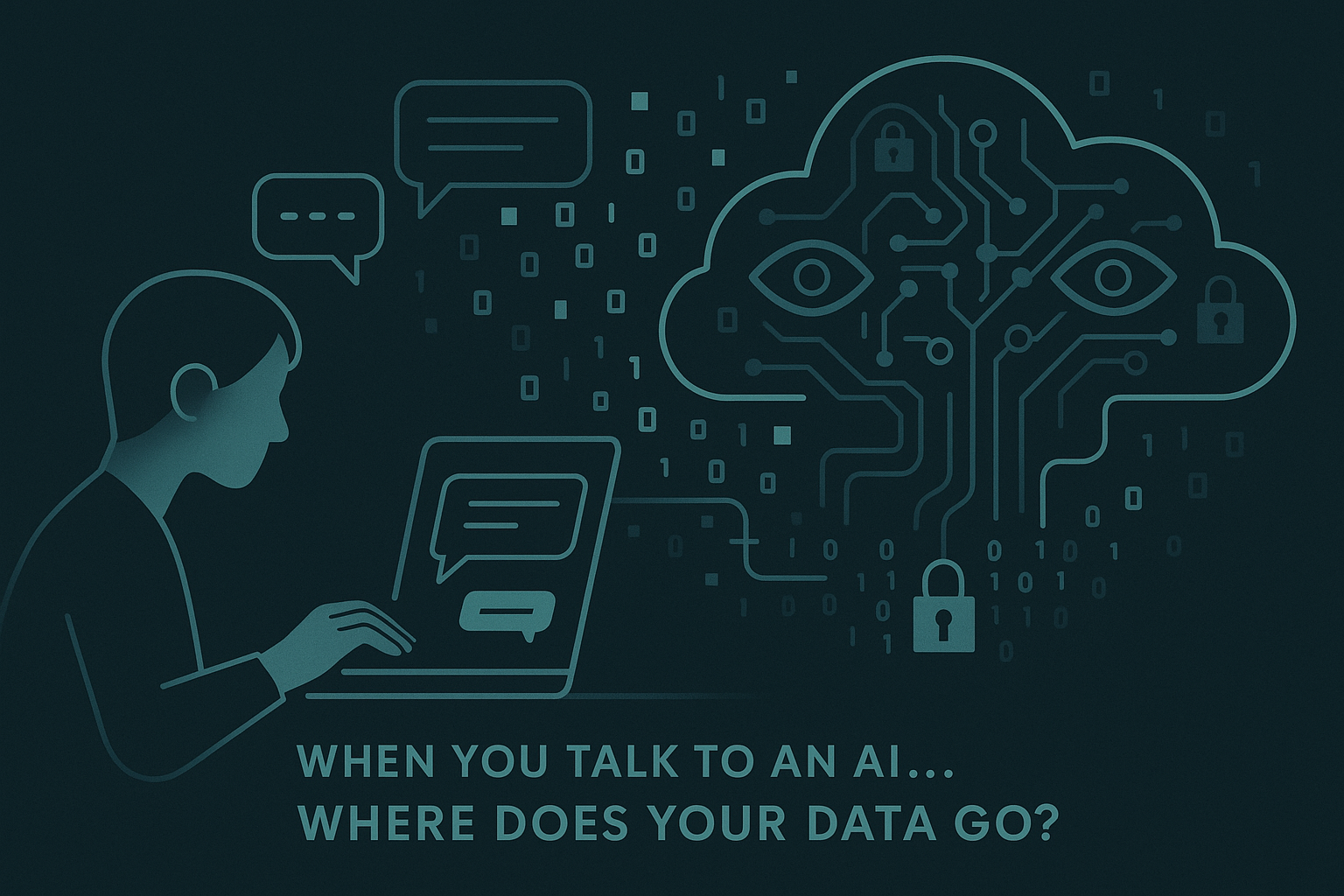
When you talk to an AI, where does your data go?
That question has been bothering me since the first time I fed a sensitive sentence into a chatbot and felt the tiniest pang of doubt. Who else might see this? Is it being stored? Could it leak? It’s the same unease as whispering a secret in a crowded café: even if no one’s listening, you still wonder.
The truth is, generative AI isn’t just about models predicting words. It’s about the data flowing in and out — data that might be personal, financial, medical, or just private. Which is why conversations about encryption, privacy, and trust are no longer side quests. They’re central.
Why “RAG + Hope” Isn’t Enough
In the last essay we explored Retrieval-Augmented Generation (RAG). It’s brilliant for grounding answers in real documents. But if those documents include sensitive data — patient records, legal contracts, corporate memos — you can’t just toss them into a vector database and call it a day.
Researchers have pointed out that embeddings themselves can leak information (Thakker et al., 2023). If you don’t encrypt the pipeline, someone with access could reverse-engineer snippets of the original text. RAG solves hallucination, but it doesn’t solve privacy.
And that’s the paradox: the very use cases where RAG is most valuable — healthcare, law, finance — are also the ones where security is non-negotiable.
The Encryption Toolbox
So what do we have in the toolbox? A lot, actually.
- Symmetric and asymmetric encryption — the bedrock. Data can be locked with a key (symmetric) or a public/private key pair (asymmetric). This is table stakes for storage and transport.
- Trusted Execution Environments (TEEs) — enclaves like Intel SGX or AMD SEV-SNP, where code can run securely, shielded even from the machine’s own OS (Sabt et al., 2015). Microsoft Azure Confidential Computing uses this to let companies run workloads without the cloud provider peeking.
- Federated learning — data stays where it is, and only model updates travel (McMahan et al., 2017). Think hospitals training a model together without ever sharing patient records directly.
- Differential privacy — adding carefully tuned noise so individual data points can’t be identified (Dwork et al., 2006). Apple uses this for iPhone analytics.
- Homomorphic encryption — the sci-fi one. It lets you compute on encrypted data without ever decrypting it (Gentry, 2009). Right now it’s slow and heavy, but progress is real.
Each technique has trade-offs — speed, complexity, cost. But together, they form the beginnings of an answer to: “How do we make generative AI safe enough for the data we actually care about?”

When Encryption Meets the Real World
Healthcare is the obvious test bed. Imagine a hospital using AI to summarize patient records. Without encryption, that’s a data breach waiting to happen. With federated learning and TEEs, the model could train locally at each hospital, with results encrypted before being shared. No raw patient data ever leaves the premises. That’s not science fiction — Google has already piloted federated learning in medical imaging (Sheller et al., 2018).
Finance is another. Banks are already experimenting with AI for fraud detection and client services. But regulators won’t tolerate “oops, the chatbot leaked account numbers.” Expect encryption-first architectures to become mandatory here.
Even creative industries aren’t immune. If a publisher feeds unpublished manuscripts into a model, they’d better be confident the system can’t leak passages to outsiders. Encryption is what separates “experimental” from “responsible.”
Culture of Distrust
Part of the challenge is cultural. Tech companies often move fast, collect data first, and patch later. But AI feels different. Trust here is fragile. One high-profile leak — imagine an AI model spitting out private Slack messages — and public confidence could shatter.
Shoshana Zuboff, in The Age of Surveillance Capitalism (2019), warned that the logic of data extraction corrodes trust. Encryption is one of the few technical counterweights we have: a way of saying, “Yes, we need your data to make this useful — but no, we can’t and won’t misuse it.”
Voices in the Debate
- Optimists argue that privacy-preserving AI is achievable: federated learning pilots show hospitals can collaborate without exposing data. Companies like OpenMined and Zama are betting on usable homomorphic encryption.
- Skeptics note the overhead: TEEs can slow workloads, and homomorphic encryption can be thousands of times slower than plaintext computation (Chillotti et al., 2020). If the tech is too slow or expensive, companies won’t adopt it.
- Pragmatists push for layered approaches: encrypt at rest, encrypt in transit, keep the most sensitive tasks on-prem, and don’t wait for perfect future math.

Why It Matters Right Now
Here’s the thing: we’re already embedding sensitive data into these systems. Law firms are feeding client briefs. Hospitals are experimenting with diagnostic assistants. Startups are plugging in financial data for automated reporting.
If we don’t build encryption into the foundation now, we’ll be bolting it on later — usually after a scandal. And history shows that once public trust is broken, it’s hard to earn back.
Closing Thought
Generative AI is dazzling when it improvises. But when it touches real lives, improvisation isn’t enough. We need certainty that what goes in stays safe. Encryption is how we get there — not a nice-to-have, but a baseline for trust.
I think of it like this: language models are powerful storytellers, but encryption makes them trustworthy confidants. And in a world where data is both currency and vulnerability, trust might be the most valuable thing we can engineer.
Leave a Reply