
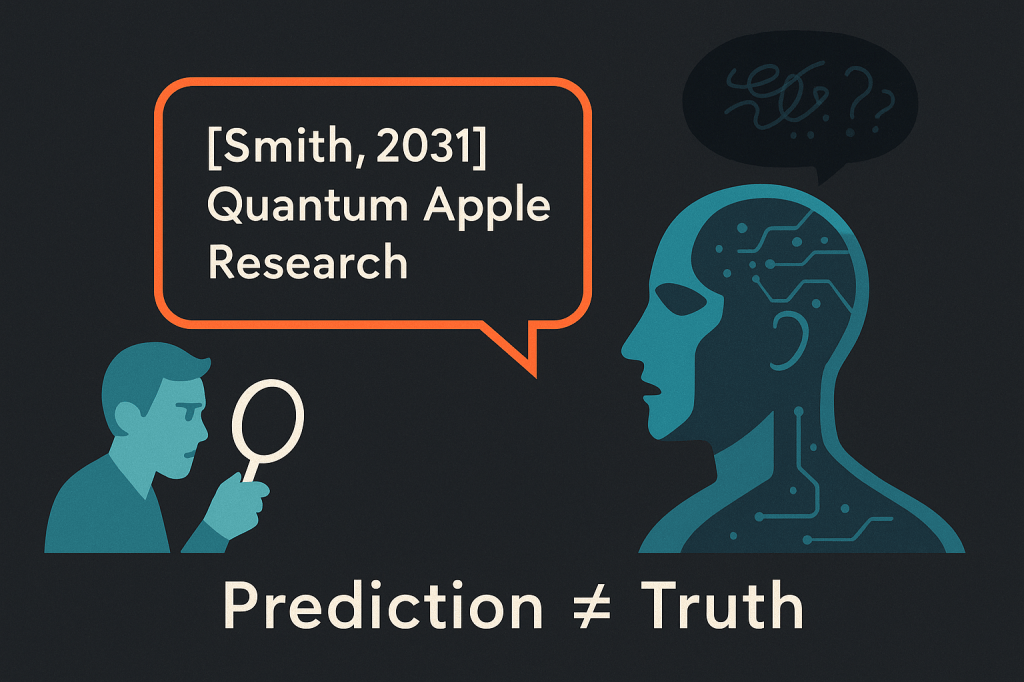
One of the funniest, and sometimes scariest, things about large language models is how confidently they’ll make things up. Ask a model to cite a research paper, and it might give you a perfectly formatted reference — to a paper that never existed. It’s like that friend who tells a great story at dinner, but later you realize half of it was embellished. Charming at a party, not so great if you’re a lawyer or a doctor.
That’s where Retrieval-Augmented Generation (RAG) comes in. It’s the AI equivalent of saying: “Hold up — before I answer, let me check my notes.”
Why Guessing Isn’t Enough
By design, LLMs are probability engines: they predict the most likely next token based on what came before (Vaswani et al., 2017). They don’t know facts — they know patterns of words. That’s why they can hallucinate false but plausible-sounding answers (Bender et al., 2021).
Imagine asking someone directions who’s too polite to admit they don’t know. They’ll point you somewhere, even if it’s wrong. That’s the LLM problem in a nutshell.
For high-stakes domains — law, medicine, finance — “plausible but false” just doesn’t cut it.
What RAG Actually Does
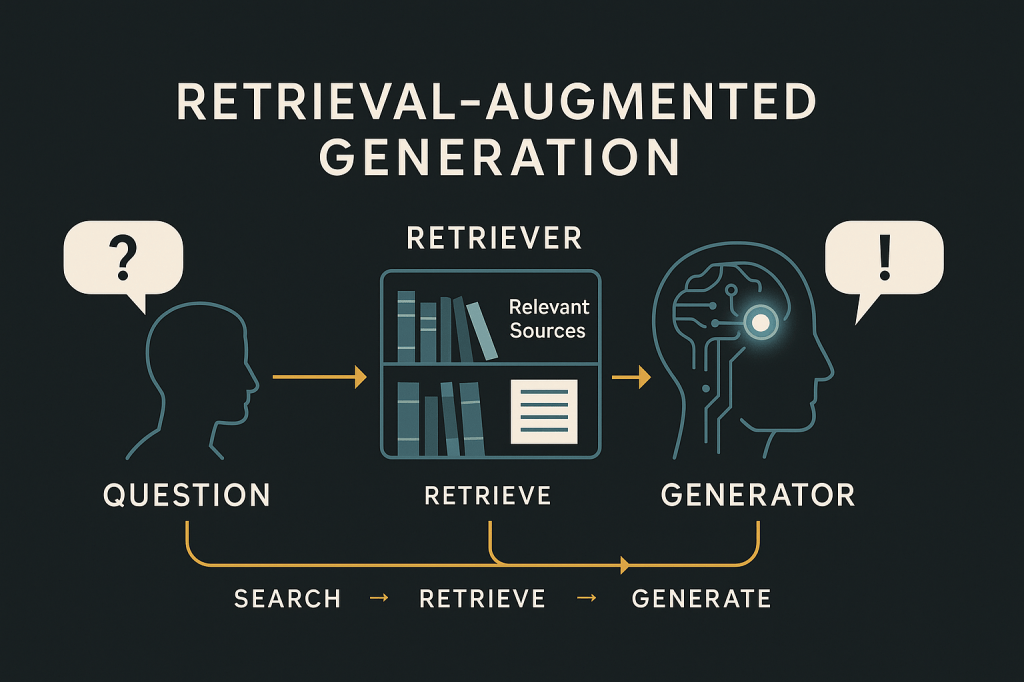
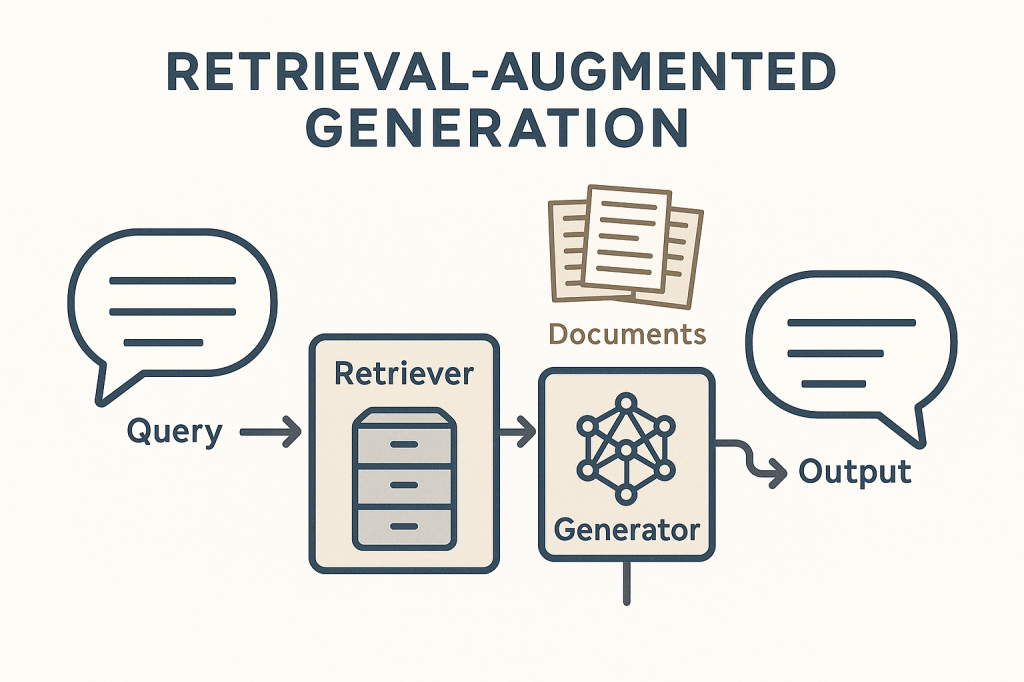
RAG bolts on a second brain: a retriever that searches an external database for relevant information, and a generator (the LLM) that uses those results to form an answer (Lewis et al., 2020).
Think of it like this:
- The retriever is your memory box.
- The generator is your storyteller.
- Together, they’re less likely to invent because they’re pulling from real documents.
Dense Passage Retrieval (DPR) (Karpukhin et al., 2020) kicked off the modern approach, using embeddings to find semantically relevant chunks of text. DeepMind’s RETRO model showed you can even bake retrieval directly into training and inference (Borgeaud et al., 2021).
Today, RAG is everywhere — from customer support bots that pull from FAQs to enterprise systems that comb through millions of documents before answering.
Why It’s Not a Silver Bullet
Here’s the catch: retrieval adds its own problems.
- Garbage in, garbage out. If your knowledge base is messy, outdated, or biased, retrieval just feeds that junk into the model.
- Latency. Searching, embedding, and re-ranking documents adds computational cost.
- Context limits. Even with long windows, models can only juggle so many retrieved passages at once.
- Privacy. Embedding sensitive data into a vector database can introduce security risks (Thakker et al., 2023).
In other words, RAG is like duct tape: incredibly useful, but not magic.
A Human Analogy
Think of RAG like studying for an exam. Without notes, you’re relying on memory alone, which means you’ll sometimes make things up with confidence. With notes, you can ground your answers in sources — but if your notes are sloppy, incomplete, or irrelevant, you’re still in trouble.
Voices in the Debate
Researchers disagree on whether retrieval is a stopgap or the future.
- Some argue retrieval is essential for grounding models in reality (Karpukhin et al., 2020).
- Others suggest longer context windows (like GPT-4’s 128k token memory) may make retrieval less necessary (OpenAI, 2023).
- Yann LeCun believes neither scaling nor retrieval alone is enough — we’ll need richer “world models” that simulate how reality works (LeCun, 2022).
That split — patch the system with retrieval vs. rebuild intelligence from the ground up — is one of the liveliest arguments in the field right now.
Why It Matters
For businesses, RAG means you can finally trust an AI to answer questions about your data instead of the internet’s. For everyday people, it means fewer hallucinated citations and more grounded outputs. But it also raises new questions: Who controls the retrieval sources? How do we keep them fresh? And what happens when people trust AI citations without checking them?
The answers to those questions will shape whether AI becomes a trusted companion or an unreliable narrator.
Closing Thought
I love RAG because it feels… familiar. It’s how humans work. We don’t hold every fact in our heads. We look things up. We check our notes. We Google.
The dream of LLMs isn’t to make them magical know-it-alls — it’s to make them good collaborators. And good collaborators don’t bluff their way through every question. They say: “Hang on, let me look that up.”
RAG is a step toward making our machines just a little more honest — and maybe a little more human.


Leave a Reply