
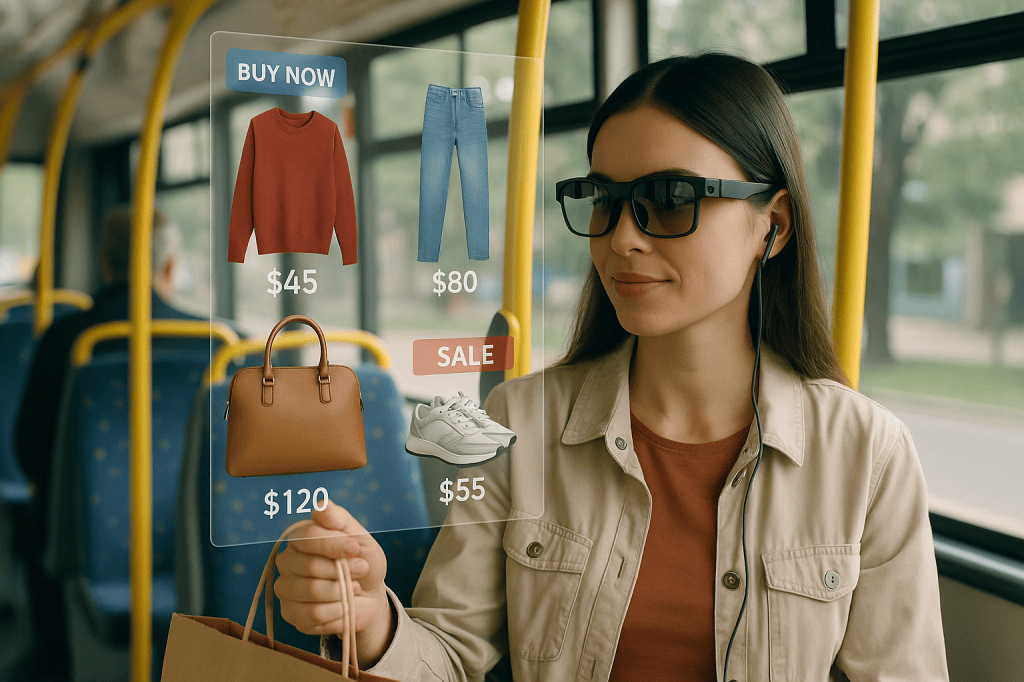
For decades, we’ve imagined the future of computing as visual. Heads-up displays. Augmented reality. Holograms floating in the air.
But look at how people actually interact with machines in moments of urgency, intimacy, or fatigue: they talk.
We talk to our cars, to our smart speakers, to Siri or Alexa when our hands are busy. We talk to colleagues to clarify what an email obscured. We talk to our kids when typing would feel cold.
And as screens shrink — into glasses, watches, or vanish altogether — voice may quietly become the dominant interface. Not because it’s flashy, but because it’s human.
The Case for Voice
The most obvious case for voice is efficiency. It’s faster to say “remind me to pick up milk” than to type it. But efficiency isn’t the whole story.
- Accessibility: Voice gives access to people who can’t comfortably type or read.
- Emotion: Tone carries nuance text strips away.
- Frictionless input: When your hands are busy — cooking, driving, carrying a child — speech slips in seamlessly.
As one Apple engineer said when unveiling their new speech models: “Voice is the original interface. Everything else has been a detour.”
Why Glass Alone Won’t Win
AR glasses are often described as the next big thing. But glasses are primarily about display. They show. They don’t always let you express.
A glance tells the system what you’re looking at, but not why you’re interested. A hand gesture can confirm, but it’s clumsy for complex queries.
Voice fills that gap. You look at a product through glasses, then say softly, “Show me a cheaper version,” or “Does this come in red?” Without speech, the interaction bottlenecks.
Glasses amplify vision, but they don’t replace the need for conversation.
Advances in Real-Time Voice
The technical leaps are happening now:
- OpenAI’s GPT-4o introduced real-time conversational voice, capable of interruptible dialogue — no more long pauses while the model “thinks.”
- Apple’s Private Cloud Compute allows Siri’s new voice functions to run with near-zero latency, mixing on-device and cloud processing.
- Google’s Gemini Live lets you interrupt and redirect mid-sentence, mimicking human conversation flow.
These upgrades fix the single biggest problem with earlier voice assistants: lag. What once felt robotic now starts to feel conversational.
The Psychology of Talking vs Typing
We underestimate how deeply talking to machines changes us.
Typing is deliberate. You edit before you hit “send.” Voice is raw, closer to thought. It exposes mood, fatigue, even deception.
Psychologists studying voice assistants note that people often project personality onto them, even when they know it’s just a model. “We talk to Alexa like a roommate,” one participant admitted in a study.
This projection matters. In agentic commerce, when you’re negotiating, venting, or asking for advice, your voice will shape how the system perceives you — and how it responds.
Interruptibility and Trust
The most human part of conversation is interruption. Cutting in, clarifying, pivoting.
Old voice assistants failed here. You’d issue a command, wait, and hope the system understood. That unnatural gap killed trust.
The new generation fixes this with what some designers call interruptibility indexes — metrics for how gracefully an AI yields when you cut it off.
Trust grows when you feel in control of the exchange. A model that can pause mid-word and adapt makes conversation feel alive rather than mechanical.

Sotto Voce and Public Etiquette
One challenge is etiquette. Talking to machines in public still feels awkward. Nobody wants to shout commands in a café.
Designers are experimenting with sotto voce UX — near-whisper interfaces that capture low-volume speech without broadcasting it to the room. Paired with glasses or earbuds, this could normalize discreet conversations with your agent.
It’s the return of a subtle intimacy: muttering to yourself, but this time, the self listens back.
Memory Knots
Voice has another advantage: it lends itself to reminders and anchors.
“Remember I don’t like cilantro.”
“Don’t let me book flights before 10am.”
These little utterances, dropped in casually, become part of the agent’s memory. Typing them out feels formal. Saying them feels natural. Over time, these memory knots bind the relationship between you and your agent, weaving context into daily chatter.
The Risk of Over-Familiarity
But familiarity cuts both ways.
Voice intimacy makes it easy to forget who you’re talking to. If your agent has a warm tone, you may disclose more than you realize — frustrations, secrets, financial stress.
Sherry Turkle, MIT sociologist, warns: “When machines sound human, we treat them as human. But they don’t share our vulnerabilities, and they don’t share our responsibilities.”
The danger is that we’ll lean on agents like friends, forgetting they’re also data pipelines for corporations.
Business Implications
For companies, voice changes how persuasion works.
- Ads fade. Conversations rise. A brand may need to develop not just a voice, but many voices calibrated to different moods.
- Sales funnels collapse into dialogues. Instead of browsing, you’ll ask: “What’s the best phone under $700?” and trust your agent’s conversation with brand agents to deliver.
- Customer service shifts into background negotiations: your agent arguing with Comcast’s agent, you occasionally jumping in with a frustrated, “Just cancel it.”
Voice makes commerce continuous and conversational, not transactional.
Regulation and Disclosure
The FTC is already considering rules requiring companies to disclose when you’re talking to an AI rather than a human. In healthcare and finance, regulators may demand voice transparency logs — recordings that show what was said and why decisions were made.
Without that, the line between authentic dialogue and manipulative scripting could blur dangerously.
Everyday Ripples
It’s worth imagining a few ordinary futures:
- The driver: instead of tapping a screen, you say, “book parking near work,” and it’s done before the light turns green.
- The parent: cooking dinner, hands covered in flour, you whisper, “add oregano to the list,” and it’s remembered.
- The older adult: alone at home, talking to their agent daily — for reminders, but also for companionship.
Voice lowers the barrier between thought and action. That convenience will feel ordinary faster than we expect.
Looking Forward
Screens may shrink. Glasses may rise. Biometrics may guide choices. But voice endures.
Because at its core, commerce isn’t just about efficiency. It’s about expression — the messy, emotional act of asking for what we want, even when we’re not sure ourselves.
Voice carries that better than text, gestures, or glances ever could. It reveals us, exposes us, sometimes betrays us. But it also keeps machines tethered to something fundamentally human: the sound of us trying to be understood.
The future may be silent negotiations between agents. But our part in it may still be spoken aloud.


Leave a Reply