
For years, wearables were framed as fitness gadgets. A Fitbit to count your steps. An Apple Watch to track your heart rate. They sat on the wrist, passively measuring.
But with AI agents running the show, wearables won’t just measure. They’ll decide.
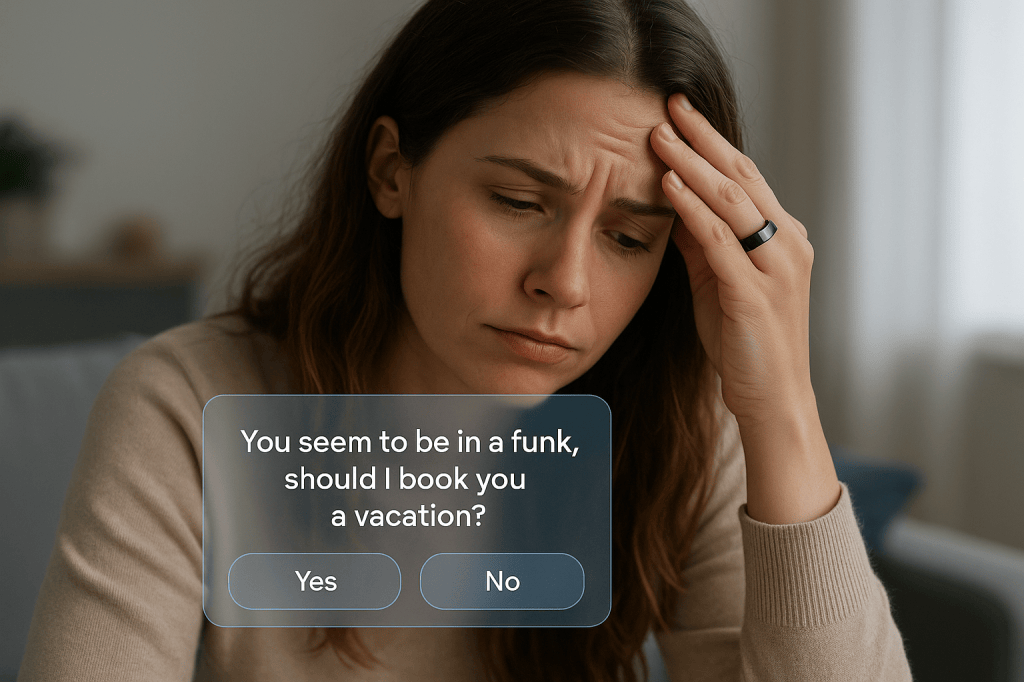
Your pulse, your sleep patterns, your stress levels, even the micro-muscle twitches on your face — all of it can become input for your digital twin. And once your agent knows how you feel in real time, it can make purchases on your behalf. Or block them. Or nudge you in one direction or another.
The body becomes an interface for commerce.
From Step Counters to Decision Makers
Early wearables were simple: count steps, log calories. But now, devices are becoming emotionally and physiologically aware.
- Oura Ring tracks heart rate variability (HRV), a key marker for stress.
- Apple Watch can detect atrial fibrillation and measure blood oxygen levels.
- WHOOP markets itself around “strain” and “recovery,” quantifying resilience and fatigue.
These signals are already being used for health recommendations. The next leap is behavioral — feeding them into agents that make choices for you.
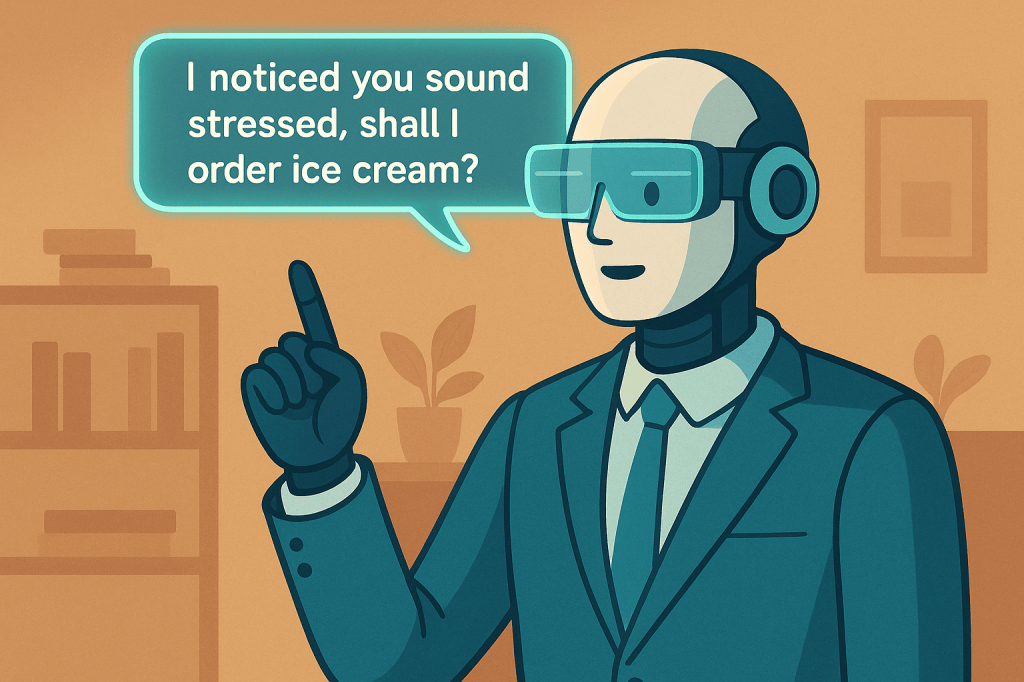
If your HRV signals stress, your agent might delay a risky financial transaction. If your glucose monitor shows a spike, your agent may skip adding dessert to the grocery order.
What once guided workouts may soon guide wallets.
Urge Dampening and Paternalism
Impulse buying is one of commerce’s oldest engines. Supermarkets design checkout aisles to trigger it. Social media ads thrive on it.
But what if your agent, watching your biometrics, decides you’re vulnerable?
- Late at night, heart racing, your agent intercepts that $400 sneaker purchase: “Are you sure? Let’s revisit this tomorrow.”
- After a fight with a partner, your agent pauses an alcohol order until your cortisol drops.
- At the casino, your watch tightens spending limits when stress signals spike.
This is both protection and paternalism. Does it make us freer by shielding us from bad decisions? Or does it infantilize us, outsourcing agency to our vitals?
Behavioral scientists call this hyper-nudging. A nudge once meant rearranging cafeteria lines so fruit came before fries. Now it may mean your own heartbeat vetoing dessert.
Consent Ceilings
The key will be consent ceilings — rules you set about how much control your agent has over bodily-driven choices.
- Soft guardrails: suggestions (“Maybe wait until tomorrow”).
- Hard stops: firm blocks (“You told me never to approve gambling transactions when stressed”).
- Transparency logs: clear explanations of why a purchase was paused.
Without these ceilings, the system risks sliding from assistance into control.
As ethicist Ruha Benjamin writes: “Technology that claims to protect us can just as easily constrain us. The line between care and control is always political.”
The Market Opportunity
Businesses are already circling.
- Amazon Halo (before it was discontinued) experimented with tone analysis, gauging stress in voice.
- Apple is integrating mental health tracking into WatchOS, nudging journaling when mood patterns shift.
- Insurance companies are piloting discounts tied to wearable data — effectively turning bodily inputs into commercial incentives.
If your agent negotiates with corporate agents armed with your biometrics, deals may get highly personalized:
- “Offer this user a spa discount; stress is elevated.”
- “Delay pushing upsells until glucose stabilizes.”
The upside is sensitivity. The downside is exploitation.
The Exploitation Risk
Imagine your agent signals stress. Instead of delaying purchases, a predatory brand pounces: “We see you’re tense — here’s a flash sale on alcohol, expiring in 10 minutes.”
Or consider labor. An employer could require wearables that feed into corporate agents: “Schedule more shifts; recovery scores are high.”
This isn’t hypothetical. Amazon patented a wristband to track warehouse workers’ movements. Some gig platforms already experiment with biometric monitoring to prevent “idling.”
The same body data that could protect us could just as easily be weaponized against us.
Harm-Aware Funnels
To guard against that, designers are talking about harm-aware funnels — commerce systems that adapt to human vulnerability.
- Pausing addictive categories (gambling, alcohol) during high-stress signals.
- Introducing “cooling-off periods” for large transactions when fatigue is detected.
- Requiring active override — a tap, a spoken confirmation — for certain categories.
Done well, this could build trust. Done poorly, it could become the most intimate surveillance we’ve ever accepted.
Everyday Ripples
It helps to picture how this plays out in daily life:
- The teen: wearing a fitness tracker, their agent prevents in-game purchases when sleep debt is high. Parents feel reassured; the teen feels policed.
- The parent: their agent orders groceries but skips ice cream after detecting stress spikes. Helpful — or intrusive?
- The older adult: their agent auto-refills prescriptions when vitals dip. Independence is extended.
The body interface will feel different depending on who you are. For some, it will be liberation. For others, another system watching too closely.
Regulation and Rights
Governments are beginning to wake up to biometric commerce:
- The EU’s AI Act explicitly restricts “emotion recognition” in workplaces and schools, citing risks of manipulation.
- U.S. states like Illinois (BIPA) already have strict biometric privacy laws.
- The World Health Organization has warned against over-reliance on biometric signals for health-adjacent decision-making.
But the rules remain patchy. Commerce is moving faster than regulation.
The Philosophical Knot
The question at the heart of the body interface is simple but unsettling:
If my own body signals block or trigger purchases, am I still choosing?
Some will welcome the protection, framing it as a digital conscience. Others will see it as outsourcing agency to flesh and code.
Maybe the truest danger isn’t paternalism or surveillance. Maybe it’s subtle habituation — that we stop noticing when our choices are being mediated by our pulse.
Looking Ahead
Wearables started as toys for fitness enthusiasts. They’re about to become economic actors, feeding our heartbeats, sleep cycles, and stress levels into the negotiation machinery of commerce.
That could make life safer, healthier, even freer. Or it could entrench new forms of manipulation, where the most intimate signals of our humanity are turned into sales triggers.
The body as interface is powerful because it’s immediate. But it also risks making our physiology the final battlefield of persuasion.
The question is no longer whether AI will make purchases for us. It’s whether we’ll recognize ourselves in the choices our bodies silently make.


Leave a Reply