
Every few months, the headlines repeat the same story: a breakthrough AI model, bigger and more powerful than the last. More parameters. More training data. More compute.
But behind the excitement is a quieter truth: only a handful of companies can afford to build these giants. The cost of training frontier models is now measured in hundreds of millions of dollars, with access to the most advanced chips tightly controlled.
That concentration of power raises a simple question: can small models win? Or are we drifting toward a future where just three or four companies effectively control the decision-making systems that shape business and consumer life?
The Centralization Problem
AI today is bottlenecked by three things:
- Compute: Access to NVIDIA’s GPUs, the lifeblood of training and inference.
- Cloud: The infrastructure to host models at scale, controlled by Amazon, Microsoft, and Google.
- Data: The licensing deals that determine who gets “clean” training sets.
Together, these factors tilt the table toward a small set of incumbents. The UK Competition and Markets Authority warned in 2023 that “a handful of firms control critical inputs across the AI value chain, creating risks of entrenched dominance.”
When a few players own the pipes, innovation starts to narrow.
The Case for Giants
It’s not hard to see why scale dominates.
Bigger models perform better at general tasks. GPT-4, Claude, Gemini — all make leaps in reasoning that smaller models can’t yet replicate. For enterprises, large models are attractive because they promise broad capabilities with a single integration.
Anthropic co-founder Dario Amodei put it bluntly: “The frontier models are where the breakthroughs happen. They’re expensive, but the payoff in capability is exponential.”
So in the short term, the gravity pulls toward giants.

The Case for Small
But bigger isn’t always better.
A parallel movement is underway toward small, specialized, and local models:
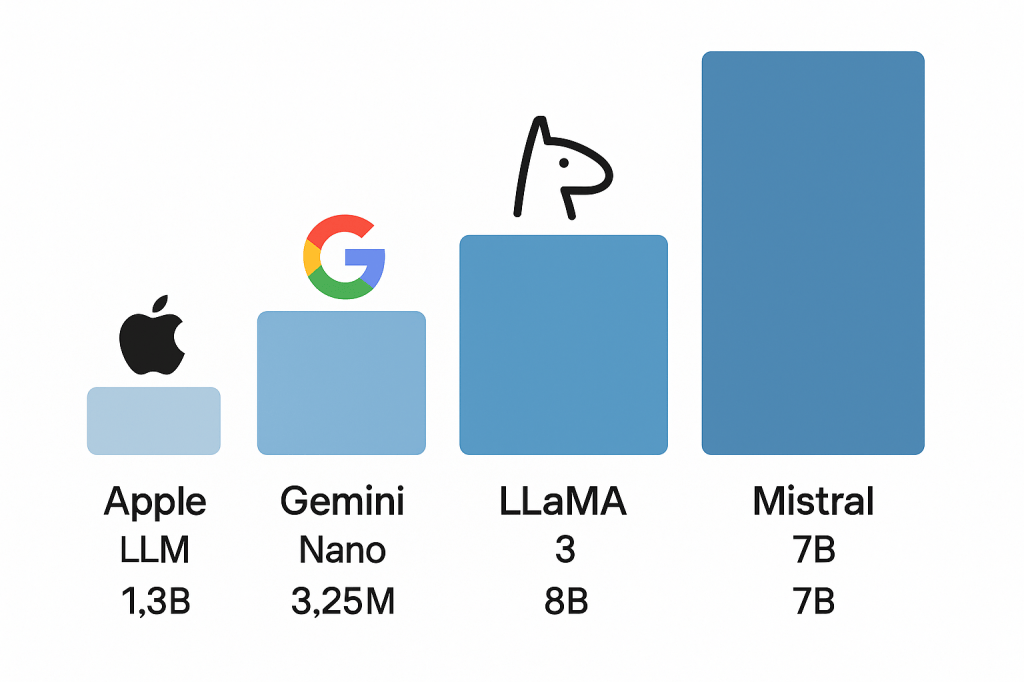
- Apple is pushing on-device AI with its Private Cloud Compute framework, promising a hybrid where sensitive tasks run locally, with only the heaviest lifts sent to the cloud.
- Google’s Gemini Nano runs directly on Pixel devices, enabling private, offline assistance.
- Open-source models like LLaMA and Mistral are powering startups that can’t afford access to frontier APIs but can fine-tune lightweight systems for specific use cases.
Small models bring advantages:
- Lower cost.
- Faster inference.
- Privacy (data never leaves the device).
- Domain specificity (a model tuned for medicine, law, or farming may outperform a generalist giant).
As one CIO told MIT Tech Review: “I don’t need a model that can write poetry. I need one that can approve loans fairly and quickly.”
Hybrid Trust Stacks
The likely future isn’t all big or all small. It’s hybrid.
Picture a trust stack:
- On-device first: Handle sensitive personal or corporate data locally.
- Trusted cloud second: Escalate to a foundation model only when needed.
- Specialist plug-ins third: Bring in niche models for domain-specific expertise.
This layered approach reduces dependency on any single provider. It also gives businesses more control over where their data goes and how much they pay.
Apple is already moving in this direction, pitching its on-device models as privacy-preserving by default, with secure “handoffs” to the cloud only when absolutely required.
The Economics of Switching
Even with hybrid stacks, the risk of lock-in is real. Switching costs in AI aren’t just contractual; they’re architectural. Once a company builds workflows around one ecosystem’s APIs, context windows, and embeddings, moving is painful.
Some analysts compare this to credit card interchange fees: invisible taxes extracted by intermediaries. In AI, the “interchange fee” may be the hidden cost of dependency on a single provider’s model architecture.
Unless open standards emerge, monopolization by compute could calcify.
Can Policy Help?
Governments are beginning to notice.
- The EU AI Act includes provisions for transparency and interoperability.
- The CMA (UK) has opened inquiries into AI market concentration.
- The FTC (US) has signaled interest in antitrust actions around AI infrastructure.
But policy tends to trail practice. By the time regulations arrive, ecosystems may already be entrenched.
As one EU commissioner put it: “We don’t want AI to repeat the mistakes of Big Tech — locked ecosystems where a handful of players set the rules.”
The Human Angle: Who Loses if Small Models Die?
It’s tempting to frame this as an industry squabble. But the stakes are deeply human.
If only a few large providers dominate, then:
- Small businesses may be priced out of access.
- Communities may lose control over how local knowledge is represented.
- Individuals may see their agents trained mostly on data from big markets, flattening cultural diversity.
On the other hand, if small models thrive:
- Doctors in rural clinics could run specialized medical models offline.
- Farmers could use lightweight models trained on local soil and climate data.
- Consumers could have more private, personalized agents running directly on their devices.
The fight over compute isn’t abstract. It’s about whether AI becomes a concentrated utility or a distributed tool.
Everyday Ripples
Imagine three futures:
- The Giant Monopoly Future: Your personal agent runs only on one of three platforms. Every negotiation, purchase, or decision flows through their servers. Innovation slows. Costs creep upward.
- The Bifurcated Future: Big models dominate discovery and creativity, but small models handle sensitive or niche tasks. A workable balance.
- The Commons Future: Communities and open-source movements thrive, with data unions and local models giving people direct control.
Which future we get depends on choices being made right now — by companies, regulators, and us.
Reflections
For decades, the story of technology has swung between centralization and decentralization. Mainframes gave way to PCs, which gave way to the cloud. AI may be repeating the cycle.
Monopoly by compute feels inevitable when headlines celebrate only the biggest models. But history suggests there’s always room for smaller, more human-scaled systems — if we fight for them.
The real question isn’t whether small models can “win” in raw capability. It’s whether they can carve out enough space to keep AI diverse, resilient, and aligned with the messy variety of human life.
Because if we let compute concentration dictate everything, we risk narrowing not just business innovation but human possibility itself.


Leave a Reply