
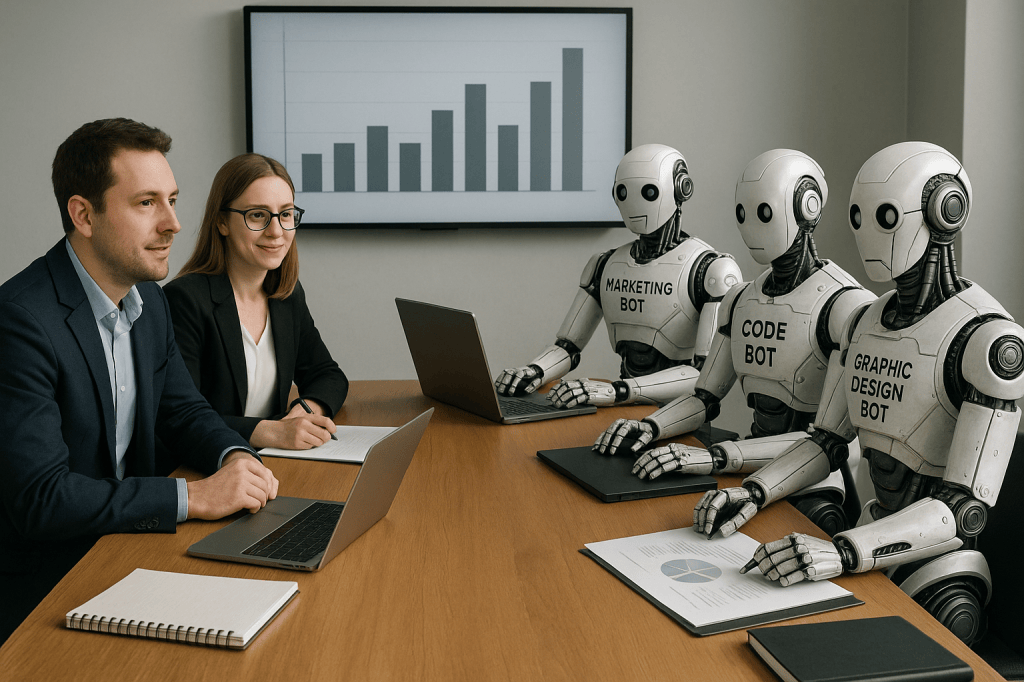
For as long as there have been offices, there have been meetings. Some useful, some endless, all fueled by the basic problem of coordinating humans. But what happens when half the “attendees” in the room aren’t people at all, but AI agents representing them?
That’s not a hypothetical. Companies are already experimenting with “agent rooms” — environments where multiple AI systems prep agendas, brief participants, track commitments, and even carry on side negotiations while the humans are busy.
It feels like the next logical step in productivity. It also feels like a culture shock.
Because if agents do the preparation, the follow-up, and much of the discussion in between, we’re forced to ask: what are meetings even for anymore?
From Assistants to Teammates
The first wave of workplace AI was framed as “copilots” — tools that summarized calls, suggested emails, or generated draft slides. Helpful, but clearly subordinate.
Now, companies like Microsoft, Anthropic, and startups building on LangChain are pushing toward multi-agent frameworks. Instead of one assistant, you get a small swarm: one agent tracking deadlines, one summarizing research, one negotiating with a vendor’s bot.
In one 2024 Microsoft demo, a “project room” contained four AI agents, each with a role. They debated strategy, assigned tasks, and produced a shared plan — all before a single human entered the chat.
As Satya Nadella put it: “The unit of work is no longer just the individual. It’s the human plus their agents.”
Meetings That Start Without You
Imagine you’re on a product team. Before the weekly check-in, your personal agent meets with the others: design’s agent, finance’s agent, marketing’s agent. They hash out open issues, identify conflicts, and draft an agenda.
When you arrive, the meeting is half over. You’re presented with a tidy summary: “Here are the three decisions that need human input. Everything else has been resolved.”
Efficient? Absolutely. But it raises an odd question: if the meeting has already been conducted by our proxies, what are we really doing there?
Cultural Whiplash
This is where the shift stops being technical and starts being cultural.
- Hierarchy: If agents negotiate scope before managers weigh in, who really decides?
- Credit: If an idea emerges from an agent room, who gets recognition — the human it represents, or the collective swarm?
- Participation: If you skip a meeting but your agent attends, are you still “present”?
Workplaces already struggle with dynamics of credit, inclusion, and decision-making. Agents risk amplifying those tensions if culture doesn’t evolve alongside them.
As Harvard Business School’s Tsedal Neeley, an expert on remote collaboration, said: “We saw with Zoom how quickly tech reshapes norms. AI agents will be even more disruptive — because they won’t just mediate communication, they’ll start to own it.”
Guardrails and Etiquette
If agent rooms are going to work, they’ll need shared norms — much like Robert’s Rules once brought order to parliaments. Some emerging ideas:
- Agenda Contracts: agents align objectives and constraints before humans join, but leave space for human override.
- Noise Limits: caps on how many updates or “suggestions” agents can flood into channels.
- Decision Journals: transparent logs showing who (or what) decided what, and why.
Without these, workplaces risk death by a thousand notifications, or worse — decisions made by bots that no one remembers authorizing.
The Optimistic Angle
Handled well, agent rooms could solve some of the oldest office problems.
- Meetings shrink because prep and follow-up are automated.
- Decisions speed up because agents resolve routine conflicts in advance.
- Inclusion improves because agents can represent quieter employees, surfacing their inputs without requiring them to interrupt.
At their best, agents don’t replace human collaboration — they clear away the bureaucracy so people can focus on creativity, strategy, and relationship-building.
A 2024 Gartner report found that teams using multi-agent prep cut meeting times by 30–40% without reducing quality of decisions. That’s not science fiction — that’s happening now.

Everyday Ripples
Picture a few futures:
- A junior employee’s agent ensures their idea gets into the pre-meeting brief, leveling the playing field.
- A vendor’s agent attends a procurement session, negotiating terms directly with a company’s finance agent while humans focus on higher-level strategy.
- A project continues seamlessly across time zones because agents carry the dialogue overnight, so no one “wakes up behind.”
Each scenario hints at a more fluid, less bureaucratic workplace — if culture adapts.
Looking Forward
The office has always been shaped by its tools: typewriters, email, Slack. Agent rooms are the next step — but a bigger one, because they don’t just speed us up, they change the very definition of participation.
The risk isn’t that agents will take over our jobs in meetings. It’s that we’ll stop thinking about what meetings are for — how we share credit, build trust, and make decisions together.
The opportunity is that if we do rethink it, we might finally make meetings into what they were supposed to be all along: spaces where human judgment, creativity, and empathy matter most.
Agents can handle the rest.


Leave a Reply