

For most of the internet age, we’ve lived under an unspoken deal: our data in exchange for free services. We searched, posted, streamed — and companies quietly collected, analyzed, and sold the traces we left behind.
Now, as AI agents become personal models trained on our history, beliefs, and behaviors, that bargain looks shaky. If your digital twin reflects you, who owns it? If a business pays to access your agent’s knowledge, should you be compensated?
The idea of data dignity — that individuals deserve recognition and value for their data — has hovered on the margins for years. But with personal agents at the center of commerce, it may finally become unavoidable.
Why Data Matters More Than Ever
Your personal agent doesn’t just know your browsing history. It knows:
- The tone you prefer in negotiations.
- Your budget ceilings and splurge exceptions.
- Your health patterns, stress levels, maybe even your biometric signals.
This is no longer just ad targeting data. It’s decision-shaping data. Whoever controls access to it controls how businesses reach you.
That makes data less like a shadow exhaust and more like a bargaining chip.
The Case for Data Dignity
The term “data dignity” was popularized by Jaron Lanier, who argued that individuals should be paid when their data is used to train systems that generate value.
For years, this felt idealistic. But licensing deals between AI firms and publishers hint at a new precedent. In 2024, OpenAI struck agreements with News Corp and the Financial Times to license content for model training. (Reuters)
If entire institutions are demanding royalties, why shouldn’t individuals? After all, your agent is effectively a micro-institution of one.
Personal Data Endowments
Imagine if your agent came with a wallet. Every time your data was accessed — to tailor an offer, train a model, or verify a claim — a micro-payment flowed to you.
This isn’t fantasy. Glen Weyl of Microsoft Research has advocated for “data unions” that pool individuals’ data and negotiate on their behalf. A 2023 paper in Nature argued that such systems could redistribute billions in value.
In practice, that might look like:
- Opt-in licensing: Your agent allows use of your purchase history for training, but only if you get royalties.
- Category filters: You consent to your grocery data being used, but not your health records.
- Collective bargaining: Neighborhoods or professions pool data to demand better terms.
Receipt-Grade Provenance
For any of this to work, provenance matters. If your agent buys coffee and that purchase influences a recommendation system, there must be a receipt trail proving where that signal came from.
The EU’s AI Act already requires “data traceability” for high-risk systems. General-purpose AI providers will need to disclose training sources. But building provenance into consumer-facing agents is the next leap: giving you a copy of every place your data went.
Without that, “data dignity” risks being a slogan rather than a system.
The Counter-Argument: Data as Exhaust
Skeptics argue that most individual data is too small to matter. Why would anyone pay you for your coffee habit when they can just buy aggregated datasets?
But that misses the point. Your personal model isn’t just one more datapoint. It’s a curated, high-fidelity reflection of your behavior. For companies trying to persuade or serve you, that’s far more valuable than another line in a dataset of millions.
As one marketing exec told Business Insider: “We don’t want raw data. We want the decisions it leads to. Agents collapse the funnel.”
That’s precisely why individuals should have a say in how that data is accessed.
Licensing Wallets: What It Could Look Like
Picture this:
- You buy running shoes. Your agent logs the purchase.
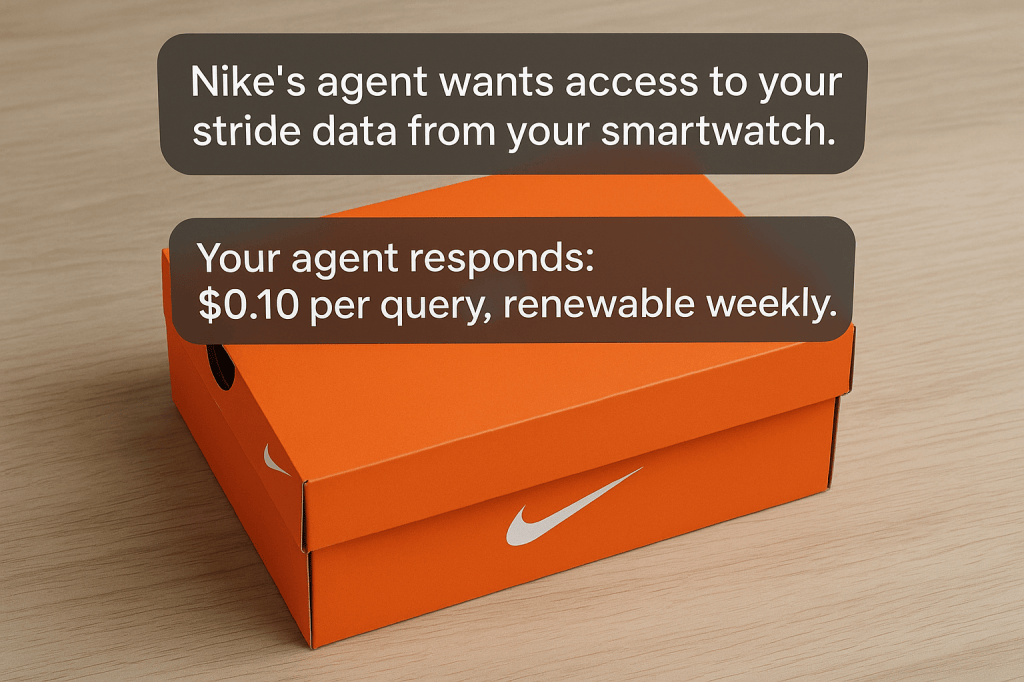
- Nike’s agent wants access to your stride data from your smartwatch. Your agent responds: “$0.10 per query, renewable weekly.”
- An aggregator offers a monthly subscription to your anonymized fitness data, paid into your licensing wallet.
This isn’t about making people rich. It’s about establishing that your data has value, and that you — not just the platforms — should capture some of it.
Risks of Data Dignity
Of course, it’s not simple.
- Equity: Wealthier consumers with richer data may earn more, widening inequality.
- Surveillance Incentives: Companies may push for ever more invasive data collection if it comes with payouts.
- Complexity: Negotiating micro-royalties across millions of interactions could overwhelm both systems and individuals.
Critics warn that “data dignity” could morph into “data exploitation,” where people feel pressured to sell intimate details to make ends meet.
Shoshana Zuboff, author of The Age of Surveillance Capitalism, cautions: “Commodifying our data risks commodifying our selves. The question isn’t just payment — it’s power.”
The Business Perspective
From a corporate view, licensing consumer data may be inevitable. Companies already pay for access to data brokers, credit reports, and loyalty program feeds. Shifting some of that value directly to individuals may actually reduce regulatory risk.
As one CIO put it in MIT Sloan Review: “If we can buy consumer trust by paying them for their data, that’s cheaper than fighting lawsuits.”
In that sense, data dignity isn’t just an ethical imperative. It’s a pragmatic adaptation.
The Small Business Dilemma
But what about small players?
Big firms can afford to license data at scale. Smaller ones may be locked out if access becomes paywalled. If every consumer agent demands micro-royalties, will local coffee shops or indie retailers even be able to compete?
There’s a risk of recreating the platform problem: only the largest companies can afford to pay, and the rest disappear from the agentic ecosystem.
That’s why some propose data commons — shared pools where smaller businesses can access anonymized consumer insights without per-user negotiations.
Everyday Lives
It’s worth picturing what this feels like day to day:
- A teenager licenses their Spotify listening history to help train a new music recommender — and gets credits toward concert tickets.
- A patient opts to share sleep data with a health startup, but only under a revocable license controlled through their agent.
- A retiree declines to license location data, even when offered cash, because they value privacy more than payment.
The dignity comes not just from money, but from choice.
Regulation on the Horizon
The legal landscape is moving fast:
- EU AI Act (2024): Requires provenance and traceability of training data for general-purpose AI.
- California’s Delete Act (2023): Gives consumers the right to opt out of data brokers with a single request.
- GPAI Framework: Pushes for global standards around data consent and portability.
These aren’t perfect, but they point in one direction: shifting agency back toward individuals.
Looking Forward
For decades, our data has been treated as corporate exhaust: captured, aggregated, monetized, rarely acknowledged. Now, with personal AI agents embodying our history and values, that stance no longer holds.
The question is no longer whether our data has value. It’s whether we, as individuals, will capture that value — or whether corporations will simply keep extracting it under new terms.
“Data dignity” may sound lofty. But it’s really about something simple: respect. If our digital twins are going to bargain, negotiate, and represent us, then the least society can do is acknowledge that the self they reflect isn’t free.
The next frontier of commerce isn’t just who wins the shelf war. It’s who gets paid for being themselves.


Leave a Reply