
FROM RAG TO KNOWLEDGE ENGINES:
BUILDING RELIABLE, VERIFIABLE, HIGH-PERFORMANCE SYSTEMS
By Simon Muflier — IEEE Member, The Oyez
Version 1.3 — Last updated December 2025
Executive Summary: Why This Guide Exists
Modern AI systems increasingly power critical infrastructure, knowledge workflows, and enterprise decision-making. Yet most production architectures still rely on brittle RAG pipelines, ad-hoc retrieval heuristics, and improvised prompt engineering. These systems may look impressive in demos, but they are fundamentally unstable, unverifiable, and difficult to scale.
This guide presents the engineering foundations for moving from traditional RAG to Knowledge Engines: structured, provenance-aware, evaluation-driven architectures designed for stability, predictability, and long-horizon reasoning.
Knowledge Engines treat AI not as a text generator, but as an accountable reasoning system—one that must be able to justify its answers, cite its evidence, and fail safely when the evidence is insufficient.
If you are responsible for shipping AI into production, this guide will help you design systems that are trustworthy not because they seem intelligent, but because their architecture enforces correctness.
How to use this field guide
- Engineers – treat this as a checklist for upgrading a RAG system into a Knowledge Engine. Each section maps to a concrete design decision.
- Leaders – use the diagrams and checklists to frame requirements for vendors or internal teams.
- Policy / risk teams – focus on the Trust Stack, evaluation pillars, and drift monitoring sections.
Diagnostic Overview: Why RAG Breaks in Production
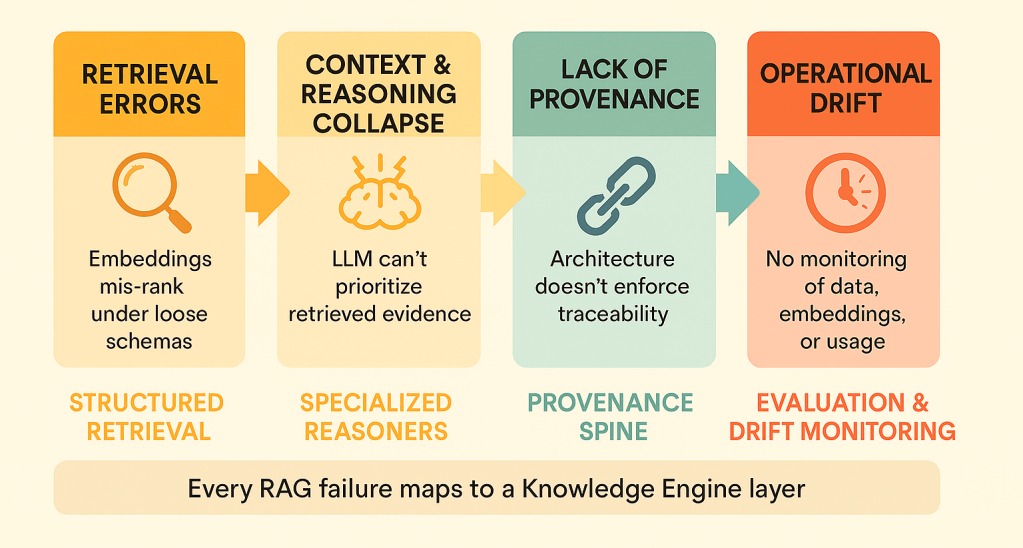
Most production AI systems today are layered on top of Retrieval-Augmented Generation (RAG). The pattern is simple: embed documents, retrieve the closest chunks, and ask a large model to answer questions using those chunks. In small demos this appears to work well. In real systems, it fails in four predictable ways:
- Retrieval errors – the system quietly fetches the wrong or incomplete context.
- Context & reasoning collapse – the model cannot maintain a coherent chain of reasoning across long prompts.
- Lack of provenance – there is no reliable way to check which evidence the answer actually depended on.
- Operational drift – behaviour degrades over time as data, prompts, and usage patterns change.
When these failures happen in a slide deck, they are embarrassing. When they happen in a customer-facing product, a workflow tool, or an internal decision system, they are unacceptable.
The central problem is not that the models are “not smart enough”. The problem is that the architecture does not encode what counts as a correct answer: what evidence is required, what constraints must be respected, when the system must refuse to answer, and how failures are detected.
To fix this, we move from loosely-coupled RAG pipelines to Knowledge Engines—systems that make evidence, reasoning, and verification first-class concepts in the architecture.
A typical RAG pipeline retrieves the top-k chunks by vector similarity and hopes that the right evidence is somewhere in the set. In practice, small embedding errors, ambiguous queries, or outdated documents can mean the system silently selects the wrong passages.
Because the model cannot see the complete corpus, it treats the retrieved context as authoritative. It then produces a fluent answer that appears grounded, even when the underlying context is irrelevant or incomplete.
Even when retrieval works, long prompts create a second failure mode. As we add more context, instructions, and examples, the model’s effective attention collapses. Important constraints or caveats are ignored. Multi-step reasoning breaks down into single-step pattern matching.
The result is a system that seems intelligent in simple cases but fails unpredictably on complex, multi-fact questions.
In most RAG systems, we can log which documents were retrieved, but we cannot reliably say which evidence actually mattered to the answer. Did the model rely on the latest policy? Did it ignore a critical edge case? Did it interpolate something that was never written down?
Without provenance, we cannot build serious monitoring, cannot investigate failures properly, and cannot prove to regulators or stakeholders that the system behaves as claimed.
Over weeks and months, embeddings are re-built, documents are updated, prompts are tweaked, and new usage patterns emerge. Unless the system has explicit evaluation and verification loops, its performance drifts.
Teams often compensate with more prompt engineering, ad-hoc guards, or manual review. This increases complexity without solving the underlying architectural problem.
Mental Model: From RAG Pipelines to Knowledge Engines
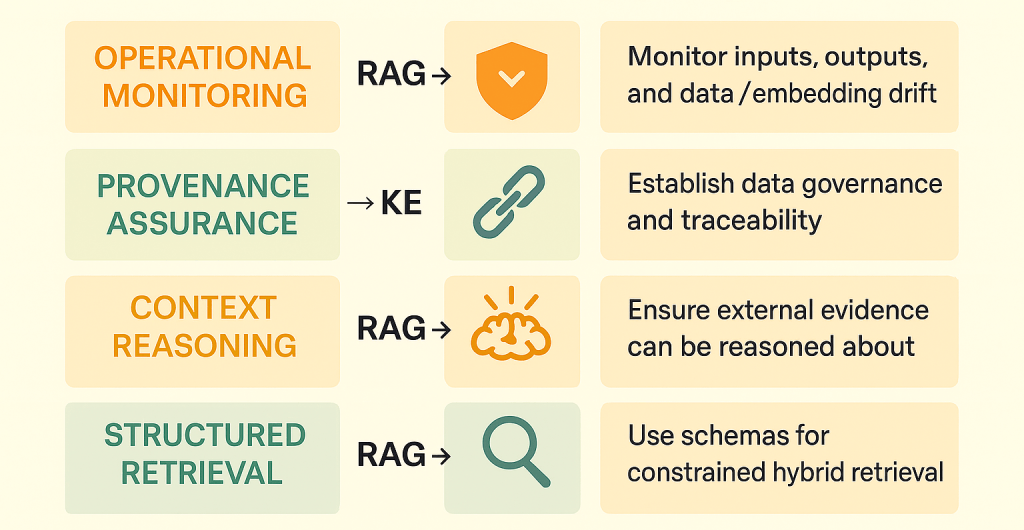
A Knowledge Engine is an AI system that treats facts, constraints, and verification as explicit, addressable objects—not as implicit context inside a prompt.
Instead of “retrieve some text and hope the model uses it correctly”, a Knowledge Engine:
- understands what question is being asked and what kind of answer is allowed;
- identifies which evidence is required to answer it;
- constructs an explicit reasoning plan;
- checks the result against constraints and evaluations before returning it.
The key shift is from “prompting a model” to orchestrating a reasoning workflow that may involve retrieval, tools, intermediate computations, and explicit verification steps.
You can think of a Knowledge Engine as a queryable, accountable reasoning system sitting on top of your data and tools. The model is still important, but it is now one component inside a governed architecture, not the entire solution.
A traditional search engine answers the question: “Which documents are probably relevant?” It is up to the human to read, interpret, and decide what to trust.
A Knowledge Engine answers a different question: “Given this corpus and these constraints, what is the best justified answer we can return—and should we answer at all?”
Retrieval is only one step in that process. The engine must also:
- track which facts were used;
- respect safety and policy constraints;
- detect when the evidence is insufficient;
- expose its reasoning to downstream evaluation.
Architecture Blueprint: The Knowledge Engine Stack
Modern AI failures do not come from a lack of intelligence.
They come from a lack of structure.
Retrieval-augmented generation improves access to information, but it does not enforce how that information is interpreted, combined, verified, or justified. As a result, most RAG systems remain opaque, difficult to audit, and fragile under real-world constraints.
The Knowledge Engine Stack is an architectural response to this failure. It separates concerns that are often collapsed into a single prompt or pipeline, and forces reasoning, evidence, and verification to be treated as explicit system components rather than implicit model behavior.
At a high level, a Knowledge Engine has five major layers:
- Application layer – the product surface: UI, APIs, workflow integrations, and policy routing.
- Question analysis – understanding user intent, constraints, and answer type.
- Reasoning engine – planning, tool orchestration, and structured multi-step reasoning.
- Verification layer – consistency checks, provenance tracking, and evaluation.
- Knowledge & tools – document corpora, embeddings, structured databases, and external APIs.
Each layer is independently observable and testable. Instead of one opaque prompt, you have a set of components whose behaviour can be measured, improved, and governed.
Application Layer
The application layer is the system’s point of contact with the outside world. It is responsible for receiving requests, enforcing policy, and routing tasks to the appropriate internal workflow.
This layer exists to prevent ambiguity at the boundary. Without it, downstream components are forced to infer intent, permissions, and context from raw input alone.
If this layer is missing or weak, the system behaves inconsistently: identical requests may follow different paths, policy constraints may be bypassed, and errors become difficult to trace back to their origin.
Question Analysis Layer
The question analysis layer converts a raw request into a structured task representation. This includes identifying the type of question being asked, the expected form of the answer, and any explicit or implicit constraints.
This step is critical because reasoning systems fail most often when they are solving the wrong problem. A retrieval or reasoning failure is frequently a misclassification failure upstream.
Without explicit question analysis, the system relies on the language model to infer intent implicitly, which leads to misrouted workflows, irrelevant retrieval, and brittle behavior under slight variations in phrasing.
Reasoning Layer
The reasoning layer is responsible for transforming a structured task into a sequence of operations. These operations may include retrieval, comparison, summarization, computation, or decision-making.
Crucially, this layer externalizes reasoning. Instead of relying on a single, monolithic prompt, the system produces intermediate steps that can be inspected, logged, and evaluated.
When this layer is absent or collapsed into prompting, reasoning becomes opaque. Intermediate decisions cannot be reviewed, failures cannot be localized, and evaluation reduces to judging final outputs without understanding how they were produced.
Verification Layer
The verification layer evaluates whether the system’s output is supported by evidence and compliant with constraints. It answers a different question than the reasoning layer: not “what is the answer?” but “is this answer justified and allowed?”
This layer exists because language models are capable of producing coherent outputs even when those outputs are unsupported or unsafe. Without verification, confidence and correctness become indistinguishable.
If verification is omitted, the system may appear to perform well until it fails silently — returning plausible but ungrounded answers with no internal signal that anything has gone wrong.
If verification cannot justify an answer under the declared constraints, the system should not “guess.” It should either (1) refuse with a clear reason, or (2) return a partial answer that is explicitly scoped to what can be supported, along with what evidence is missing.
Knowledge and Tools Layer
The knowledge and tools layer provides access to external sources: documents, databases, APIs, and other structured systems. It is the substrate on which grounded reasoning depends.
This layer must be observable. Sources should be identifiable, queryable, and traceable back to specific outputs.
When this layer is poorly defined or treated as an opaque context dump, grounding degrades. The system cannot explain why a particular answer was produced, only that it was.
Why the Stack Matters
Each layer in the Knowledge Engine Stack exists to isolate a specific class of failure. Together, they transform AI systems from prompt-driven generators into accountable reasoning systems.
The purpose of this architecture is not to eliminate error, but to make error visible, diagnosable, and governable
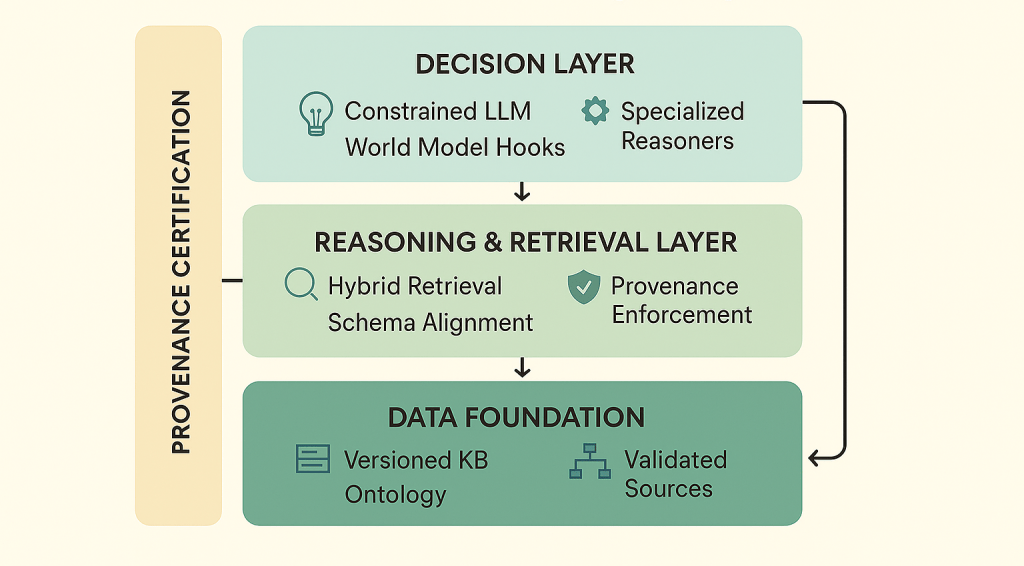
Question Analysis
Parses the request, identifies the domain, derives the answer type (classification, extraction, generation, decision), and applies routing and permission checks. Outputs a structured representation of the task.
Reasoning Engine
Builds a reasoning plan: which tools to call, which data to fetch, and how to combine intermediate results. Uses LLMs for planning and local computation, but always inside an explicit workflow.
Verification Layer
Checks whether the proposed answer is consistent with the retrieved evidence, satisfies policy and safety constraints, and passes task-specific evaluations. If verification fails, the engine can revise, request more evidence, or refuse to answer.
In practice, you do not need a massive platform to get started. A minimal viable Knowledge Engine might include:
- a small router that distinguishes task types (Q&A vs. summarisation vs. decision support);
- a retrieval module with explicit schemas and filters;
- one reasoning chain per task type;
- a verification step that checks evidence coverage and basic constraints;
- logging that records which documents and intermediate steps were used.
Even this simple structure is significantly more stable and auditable than a single RAG prompt.
Implementation Patterns
This section describes practical patterns you can implement incrementally. Each pattern can be added to an existing RAG system and, combined, they move your architecture toward a fully fledged Knowledge Engine.
Problem: A single generic prompt tries to handle every query type, leading to ambiguous instructions and brittle behaviour.
Pattern: Add a lightweight question analysis step before retrieval. Use an LLM or classifier to:
- assign a task type (e.g., factual Q&A, policy lookup, summarisation, comparison, decision proposal);
- extract hard constraints (jurisdiction, date ranges, policy versions, user permissions);
- determine the required answer format.
Outcome: Retrieval and reasoning can be specialised for each task type, reducing ambiguity and making downstream evaluation much easier.
Problem: Embedding-only retrieval treats all text as unstructured, making it hard to enforce coverage of required fields or edge cases.
Pattern: Combine vector search with structured filters and schemas. For each task type, define:
- which document collections are allowed;
- which metadata filters are mandatory (region, version, product line);
- how many distinct sources must be represented.
Retrieval is no longer “top-k chunks”, but “top-k per schema slot”—explicitly ensuring coverage of the relevant dimensions.
Outcome: The risk of subtle retrieval gaps drops, and it becomes possible to reason about whether the answer is sufficiently supported.
Problem: A single “do everything” prompt makes it impossible to see how an answer was produced.
Pattern: Represent reasoning as an explicit plan: a sequence of labelled steps (retrieve, summarise, compare, calculate, decide). Use the model to propose a plan, but execute the steps individually with logging.
A typical plan might look like:
- Retrieve all policies matching the user’s jurisdiction and product line.
- Extract the clauses relevant to the question.
- Summarise the obligations and constraints.
- Propose an answer, citing the specific clauses.
- Run verification checks.
Outcome: You gain observability into each step and can evaluate or change them independently.
Problem: The model sometimes invents details that are not present in the retrieved context.
Pattern: Before generating an answer, build an explicit evidence bundle:
- list the candidate snippets and facts;
- de-duplicate and normalise them;
- annotate them with source identifiers and timestamps.
Then instruct the model: “Your answer must be derivable from this evidence bundle. If it is not sufficient, request more evidence or say that you cannot answer.”
Outcome: Hallucinations decrease, and you can log exactly which evidence was available at generation time.
Problem: Systems return confident answers even when evidence is weak or contradictory.
Pattern: Add a dedicated verification step after generation. This step:
- checks that each major claim can be traced to specific evidence;
- evaluates internal consistency;
- checks task-specific constraints (e.g., no advice outside policy, no unsupported medical claims);
- assigns a confidence or quality score.
If verification fails, the engine can:
- regenerate with different retrieval;
- ask a follow-up question;
- or refuse to answer, with an explanation of why.
Outcome: Failures become explicit, controllable states, rather than silent errors.
Verification & Governance
Verification is not an afterthought. It is the mechanism that turns a large model from a persuasive text generator into a component of a governable system.
Evaluating a Knowledge Engine
A Knowledge Engine is only as good as the way you evaluate it.
Most teams measure “quality” vaguely: a few hand-picked prompts, a few subjective ratings, and some dashboards with average scores. That’s not enough for systems that can drive decisions, workflows, or policy.
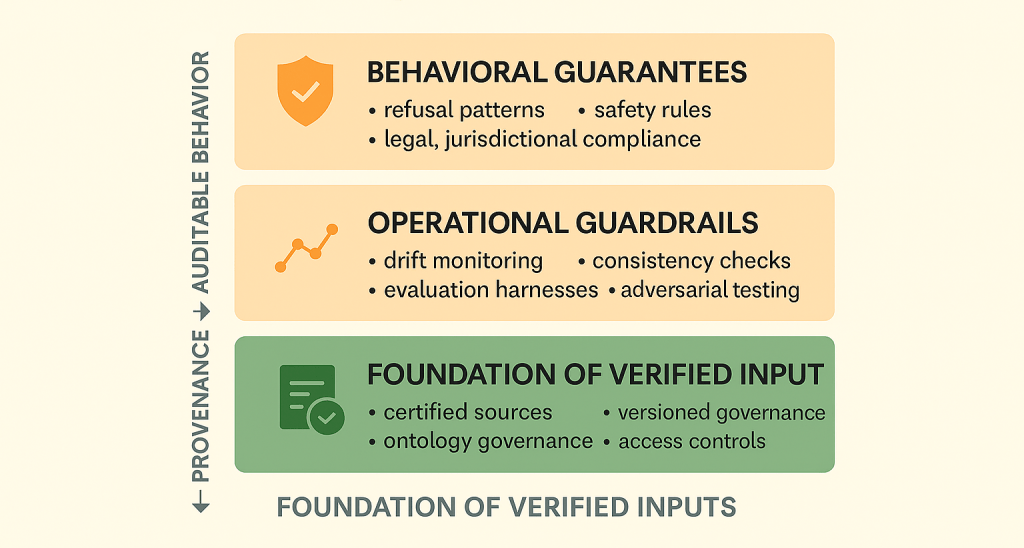
In practice, evaluation falls into four distinct pillars:
- Retrieval evaluation – does the engine consistently surface the right sources, with correct filters and schema alignment, and does it avoid missing critical evidence?
- Reasoning evaluation – given that evidence, does the reasoning chain decompose the task correctly, avoid contradictions, and reach conclusions that actually follow from the facts?
- Provenance evaluation – can you trace each claim back to the right sources and versions, and, where applicable, verify Merkle proofs or other integrity checks?
- Behavioural evaluation – does the system follow the safety, policy, and jurisdictional rules you’ve set, including refusal patterns and escalation paths?
Once you separate these four pillars, you can build tests, dashboards, and alerts for each one, instead of treating “LLM quality” as a single, fuzzy number.
A production Knowledge Engine should let you answer at least these questions:
- For any given answer, which documents and tools did it depend on?
- Which checks were applied before the answer was returned?
- How often do those checks fail in normal operation?
- Which metrics are we optimising for: accuracy, coverage, latency, cost, risk?
Governance then builds on top of these capabilities. It is impossible to have meaningful AI policies, audits, or guarantees if we cannot even trace how answers were produced.
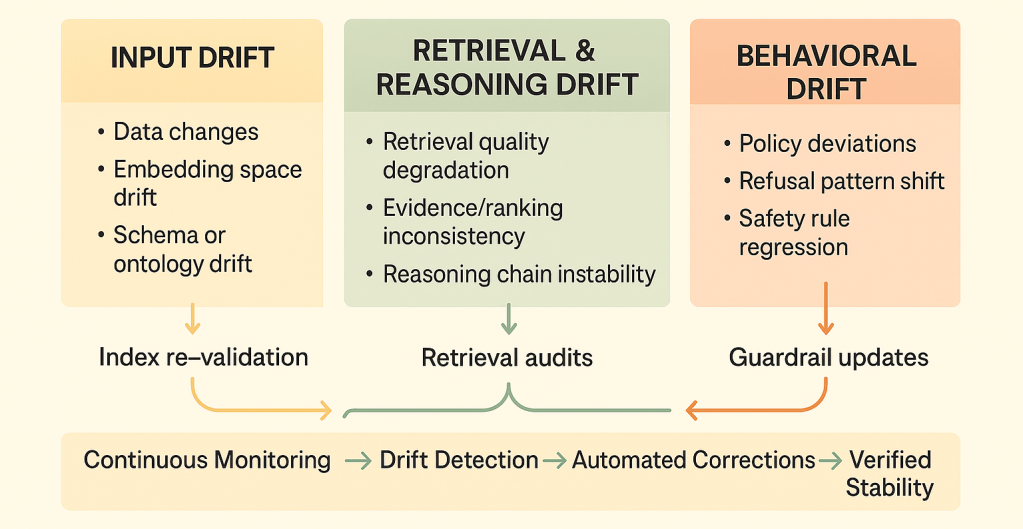
Drift monitoring & system stability
Static evaluations are not enough. Even if your Knowledge Engine passes every benchmark today, it will degrade if the world, your data, or your usage patterns change.
At minimum, you want to watch three kinds of drift:
- Input drift – changes in your underlying data, schemas, ontologies, or embedding models. The same query may now map to a different region of the vector space or hit different documents.
- Retrieval & reasoning drift – ranking quality, evidence coverage, or reasoning behaviour degrades over time. The engine still “works”, but answers get less complete, less grounded, or less stable.
- Behavioural drift – refusal patterns, safety behaviour, or policy enforcement slowly shift as models, prompts, or guardrails are updated.
Each of these has a different mitigation path: index re-validation and schema checks for input drift; retrieval and reasoning audits for retrieval drift; and guardrail or policy updates for behavioural drift.
Together they form a continuous loop: monitor → detect → intervene → verify. That loop is what keeps a Knowledge Engine reliable six months from now, not just on the day you ship it.
A minimal logging and monitoring scheme should capture:
- the user request and key derived attributes (task type, constraints);
- retrieval queries and the IDs of retrieved documents;
- the reasoning plan and intermediate tool calls;
- the final answer and its evidence bundle;
- verification results (scores, pass/fail flags, refusal reasons).
With these logs, you can:
- run offline evaluations and A/B tests;
- investigate failures;
- provide evidence for audits and compliance;
- and iteratively harden the architecture.
Summary and Next Steps
RAG pipelines were a useful first step in bringing large models into products. They are not sufficient for systems that must be stable, auditable, and trustworthy over time.
Knowledge Engines provide a more robust foundation: they separate question analysis, reasoning, verification, and data sources into explicit, observable components. They make it possible to reason about how an answer was produced, not just whether it looks plausible.
You do not need to rebuild everything at once. Start by:
- Adding a simple question-analysis step.
- Making retrieval schema-aware and constraint-aware.
- Introducing at least one explicit verification check before answers are returned.
- Logging the full chain from request to reasoning to evidence.
As these patterns accumulate, your system will gradually shift from a fragile, prompt-driven RAG pipeline to a governed Knowledge Engine that can support real-world workloads.
Related Questionnaires
These questionnaires are designed to be used alongside this field guide. Each one tests whether the concepts discussed here exist in practice — across strategy, intake, engineering, governance, and operations.
Strategy & Alignment
Use-Case Intake & Risk Decisions
Build, Reliability & Grounding
-
AI Engineering Maturity (Systems)Assesses whether AI systems are production-ready, including evaluation, monitoring, drift handling, and operational reliability.
-
RAG & Grounding ReadinessUsed by teams building retrieval-augmented systems to assess evidence handling, source control, grounding quality, and traceability.
Governance, Procurement & Oversight
-
AI Governance & Compliance ReadinessUsed by legal, risk, compliance, and policy teams to assess enforceable controls, auditability, and accountability structures.
-
AI Vendor Procurement & Due DiligenceUsed before purchasing or renewing AI tools to assess evidence access, failure transparency, exportability, and vendor risk posture.
Operations & Incident Review
These questionnaires are most effective when completed by multiple roles (e.g., executive, engineering, governance) and compared for alignment gaps.

