
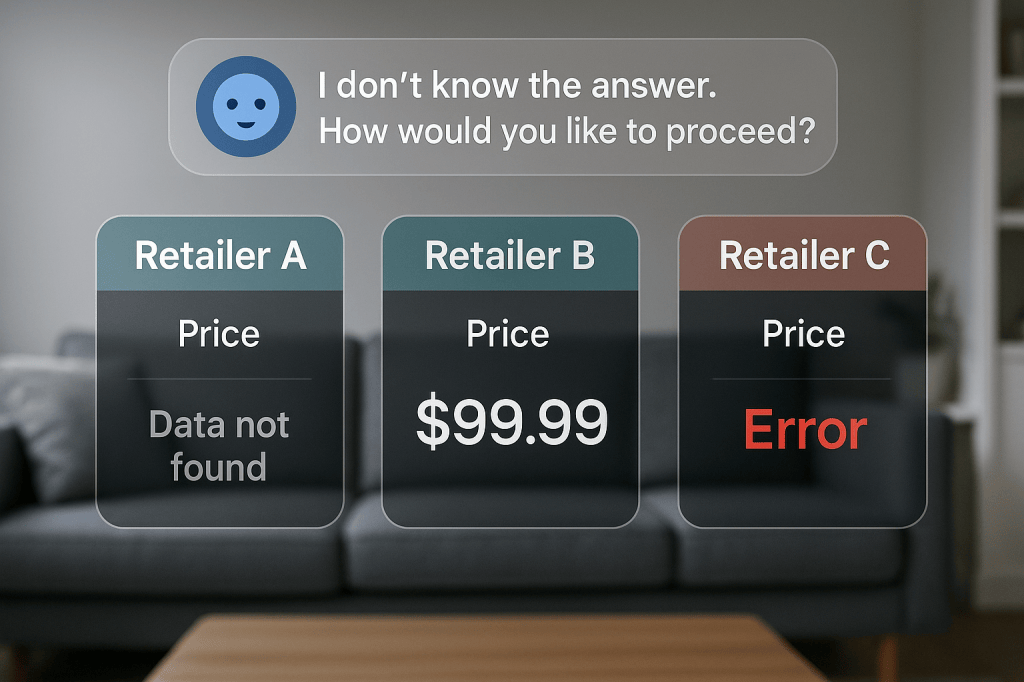
For decades, brands have been trained to project confidence.
The confident commercial. The reassuring tagline. The customer service rep who, no matter the problem, assures you it can be fixed.
But in a world of AI agents mediating the conversation between companies and consumers, confidence without truth is a liability. If your corporate agent makes claims it can’t back up — or worse, hallucinates an answer — the cost isn’t just a bad transaction. It’s the collapse of trust in the entire system.
That’s why the next big frontier in brand strategy may be counterintuitive: teaching agents to admit when they don’t know.
The Business Case for Humility
In 2024, Google rolled out AI Overviews in search — instantly controversial after examples surfaced of bad answers, from telling users to put glue on pizza to recommending toxic substances. The backlash wasn’t just about the errors. It was about tone. The answers were delivered with the same crisp confidence as correct ones.
Consumers are forgiving of mistakes when they’re acknowledged. But they’re far less forgiving of errors wrapped in false certainty.
“Humility is becoming a profit center,” said Charlene Li, analyst and author of The Disruption Mindset. “In the agentic economy, brands that overpromise and mislead will lose shelf space in people’s trust networks.”
Low-Confidence Choreography
So what does humility look like in an agent conversation?
- Low-Confidence Flags: Instead of bluffing, the agent marks answers as “uncertain” and escalates to a human or provides multiple sources.
- Source-First Responses: Cite the data or study first, then add commentary. The evidence precedes persuasion.
- Graceful Escalation: If the agent doesn’t know, it should hand over the context seamlessly to a human rep, not abandon the customer midstream.
These are not technical afterthoughts. They’re strategic decisions about brand voice and trust.
Trust in a Post-Advertising World
We’re already seeing the erosion of traditional advertising. Agents don’t click banner ads. They don’t care about slogans. What matters is whether your brand’s facts, data, and commitments align with a consumer’s constraints.
In this environment, trust is the currency. And trust is built not on perfection, but on transparency.
A 2023 Edelman Trust Barometer report found that 78% of consumers say honesty about limitations increases their trust in a brand, even if it means hearing “we don’t know.”
The takeaway: certainty is overrated. Clarity matters more.
The Internal Challenge
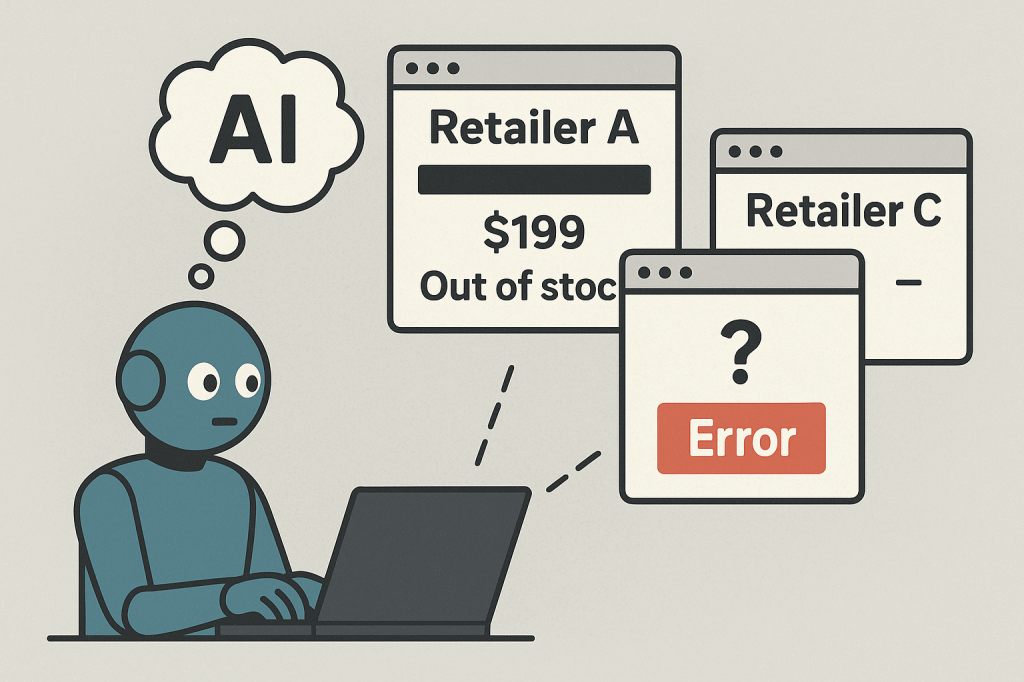
Teaching an AI agent to admit uncertainty runs against decades of marketing culture. Most executives recoil at the idea of their customer-facing systems ever saying “I don’t know.”
But in practice, that’s already how frontline staff earn trust. A doctor who says, “I’m not sure — let me check,” feels more credible than one who rattles off an answer without pause.
In the same way, brand agents that acknowledge limits will stand apart in a sea of synthetic confidence.
“Overconfidence is an alignment problem,” said AI researcher Dan Hendrycks. “We need agents to calibrate — to match their tone to their actual certainty. That’s how you keep humans in the loop.”
The Cost of Getting It Wrong
The risk isn’t theoretical.
- A financial services chatbot gives misleading advice — the firm faces regulatory fines.
- A healthcare agent provides inaccurate dosage information — lives could be at risk.
- A retail assistant misstates a warranty — consumers flood social media with outrage.
These failures don’t just erode trust in one brand. They erode trust in the entire idea of agent-mediated commerce.
That’s why regulators are paying attention. The UK’s Competition and Markets Authority (CMA) has already issued warnings about “overconfident AI outputs” in financial products. The EU AI Act requires “transparency around system limitations.” These are early signals: humility won’t just be a brand strategy — it will be a compliance mandate.
Humility as Differentiation
Imagine two scenarios.
- Brand A’s agent insists it can get you a delivery tomorrow, but misses the window.
- Brand B’s agent says: “I can’t guarantee tomorrow delivery. Based on current logistics, it looks like two days. Would you like me to escalate?”
Who do you trust next time?
Humility isn’t weakness. It’s differentiation. It signals that a brand respects your intelligence — and respects your agent’s ability to weigh trade-offs honestly.
Everyday Ripples
The shift to humility will touch daily life in subtle ways:
- Your travel agent AI offers three hotel options, noting: “I don’t have reliable reviews on this one yet — would you like me to check with a human?”
- Your bank’s agent admits: “I can’t give you financial advice — but here’s a licensed planner who can.”
- Your healthcare provider’s AI defers: “This looks like a borderline case. I’ll hand this over to a nurse immediately.”
Each moment preserves dignity — because the agent is acknowledging its limits rather than pretending to be omniscient.
Reflections
For a century, advertising and customer service have rewarded the illusion of certainty. But in an era of agents, false certainty is poison.
The brands that thrive won’t be the ones that act like they know everything. They’ll be the ones that know when to stop talking.
Humility may feel unnatural in corporate culture. But it’s the only way to build trust in systems where humans no longer see the negotiation.
The future of brand voice isn’t louder. It’s quieter. And sometimes, it will be three simple words: “I don’t know.”


Leave a Reply